 Frying pans & Sauté pans
 Non-stick
 Stainless steel
 Carbon steel
 Cast iron
 Cooking pots
 Demeyere Silver
 Scanpan Impact
 Scanpan Fusion 5
 Silampos Supreme Pro
 Silampos Grand Hotel
 Stellar Profile
 Stellar Equinox
 Stellar Eclipse
 Habonne Royal
 Korkmaz Proline
 Korkmaz Perla
 Sauteuses
 Dutch ovens
 Chasseur
 Lava
Lava Victoria
 Other
Other Grills & Grill pans
 Woks
Woks Carbon steel & cast iron
 Stainless steel
 Non-stick
 Kettles
 Fondue
 Tajines
 Pressure cookers
 Smoking pans
 Poffertjes pans
 Lids
Lids Splatter screens
 Miscellaneous
 Paella
 Japanese knives
 Kai Shun Classic
 Kai Shun Classic White
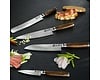 Kai Shun Premier
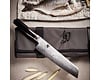 Kai Shun Premier Minamo
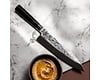 Kai Shun Pro Sho
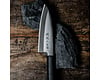 Kai Kinju & Hekiju
 Kai Seki Magoroku KK Yanagiba
 Kai Seki Magoroku Kaname
 Seki Magoroku Migaki
 Kai Seki Magoroku Redwood
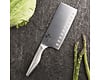 Kai Seki Magoroku Shoso
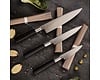 Kai Wasabi Black
 Kai Specialties
 Miyabi 7000 D
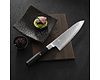 Miyabi 4000 FC
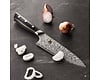 Miyabi 800 DP
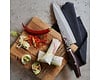 Miyabi 6000 MCT
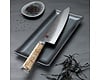 Miyabi 5000 MCD
 German knives
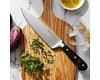 Wüsthof Classic
 Wüsthof Classic Ikon
 Wüsthof Ikon
 Wüsthof Epicure
 Wüsthof Gourmet
 Burgvogel Oliva
 Robert Herder
 French knives
 Elephant ****Sabatier forged stainless steel pakkawood
 Elephant ****Sabatier forged stainless steel olivewood
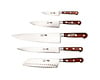 Elephant ****Sabatier forged carbon steel pakkawood
 Elephant ****Sabatier forged carbon steel olivewood
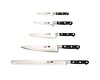 Elephant ****Sabatier stamped stainless steel
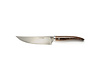 Laguiole en Aubrac Gourmet
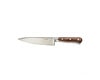 Laguiole en Aubrac Classique
 Pallares Solsona
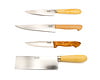 Carbon steel kitchen knives
 Stainless steel kitchen knives
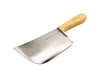 Cleavers
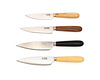 Steak knives
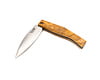 Folding knives
 Steak knives
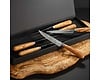 Pallares Solsona
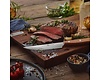 Wüsthof
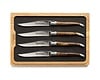 Laguiole en Aubrac
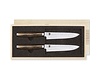 Kai / Shun
 Saladini
 Laguiole Style de Vie
 Other
Other Honing and sharpening
 Naniwa Chosera Pro
 Naniwa Advance
 Naniwa Standard
 Other whetstones
 Sharpening rods
 Honing steels
 Knife sharpeners
 Accessories
 Accessories
 Knife guards
 Knife magnets
 Knife blocks
 Knife bags
 Bread knives
 Cleavers
 Knife sets
 Simple kitchen knives
 Folding knives
 Victorinox
 Spyderco
 Böker
Böker Coutellerie G.R.
  Laguiole en Aubrac
 Nontron
 Opinel
 Cheese knives
 Oyster knives
 Miscellaneous
 Stellar Poise
 Graters, shavers, mandolines
 Mandolines
 Microplane Master
 Microplane Premium Classic
 Microplane Gourmet
 Microplane Professional
 Other Microplanes
 Other
Other Silicone tools
 Whisks
 Strainers & Colanders
 Spatulas
 Stainless steel
 Silicone
 Wood & Pressed wood
 Plastic
 Mortars & Pestles
 Tongs & Tweezers
 Kitchen shears
 Garlic presses
 Mills & Grinders
 Peugeot Paris
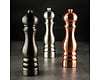 Peugeot Paris Chef
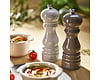 Peugeot ParisRama
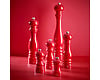 Peugeot Paris Rouge Passion
 Peugeot various
 Zassenhaus
 Brushes
 Ladles & Serving spoons
 Nutcrackers
 Peelers
 Oyster, lobster, snail
 Mashers
 Skimmers / frying scoops
 Funnels
 Ice cream scoops
 Pizza shovels & Pizza stones
 Can openers
 Squeeze bottles
 Meat mallets
 Skewers
 Miscellaneous kitchen aids
 Tortilla presses
 Citrus presses
 Baking tins & molds
 Springform pans
 Quiche & flan tins
 Bundt pans
 Cake & bread tins
 Muffin trays
 Madeleines, savarins, angel food
 Non-stick
 (Anodized) aluminum
 Silicone
 Cast aluminum
 Ceramic
 Baking trays
 Pastry rings
 Small baking molds
 Baking cups
 Paper Panettone molds
 Chocolate
 Polycarbonate molds
 Silicone molds
 Miscellaneous chocolate tools
 Chocolate food coloring
 Chocolate
 Books
Books (Cookie) cutters
 Cutter sets
 Cookie cutter sets
 Individual cookie cutters
 Piping bags & nozzles
 Sets
Sets Piping bags
 Round piping nozzles
 Star piping nozzles
 Miscellaneous
 Accessories
 Mixing bowls
 Rolling pins
 Bread
Bread Dough scrapers
 Palette knives
 Fondant tools
 Modeling tools
 Impression mats
 Smoothers, combs & spatulas
 Fondant cutters / modelers
 Mats, paper and foil
 Acetate foil
 Silicone mats
 Cooling racks
 Brushes
 Turntables
 Cake servers
 Cake cutters / knives
 Candles
 Cake boxes
 Cake drums
 Other
Other Food coloring | gel
 Food coloring | oil based
 Food coloring | liquid
 Food coloring | powder
 Color spray & Velvet spray
 Edible markers
 Flavors
 Patis Decor natural flavors
 Patis Decor flavors
 PME flavors
 Extracts
 Glitters & decorations
 Magic sparkles (glitter flakes)
 Lustre snow
 Sugar flowers and decorations
 Sprinkles
 Fondant, Marzipan & Icing
 Fondant
 Royal icing, lace, etc.
 Biscuit Icing
 Cake drips
 Misc. ingredients
 Sugars and sugar substitutes
 Gold and silver leaf
 Mixes
Mixes Ravioli stamps
 Ravioli molds
 Pasta wheels / rollers
 Rolling pins
 Pasta makers
 Various
 Peugeot Ceramics
 Rectangular
 Square
 Other
Other Casseroles
 Roasting trays
 Terrines
 Thermometers
 Measuring jugs
 Scales
 Kitchen timers
 Measuring cups & spoons
 Other
Other Japanese tableware
 Gift sets
 Bowls
Bowls Salad bowls
 Plates
 Chopsticks
 Chopstick rests
 Cutlery
 Stellar Rochester
 Stellar Sterling
 Stellar Winchester
 Stellar Raglan
 Salad bowls
 Salad servers
 Butter dishes
 Butter knives
 Heim Söhne spoons
 Trivets and coasters
 Glasses
 Serving trays
 Other
Other Percolators / moka pots
 Bialetti parts
 French presses
 Milk frothers
 Coffee grinders
 Tampers
 Espresso tools
 Milk jugs
 Coffee filters
 Tea
Tea  Teapots
 Wine tools
 Waiter's friends / corkscrews
 Decanters
 Wine coolers
 Other
Other Cocktail tools
 Misc. bar tools
 Aprons
 Kitchen towels
 Oven mitts & pot holders
 Other
Other Wood
Wood Plastic
 Pressed wood fiber
 Wood oil
 Pots & Pans
 Knives & accessories
 Kitchen aids
 Baking & pastry
 Edibles
 Pasta
Pasta Oven
Oven Measuring
 Tableware
 Coffee & Tea
 Bar & wine
 To go & storage
 Textiles
 Books
Books Boards
 Olivewood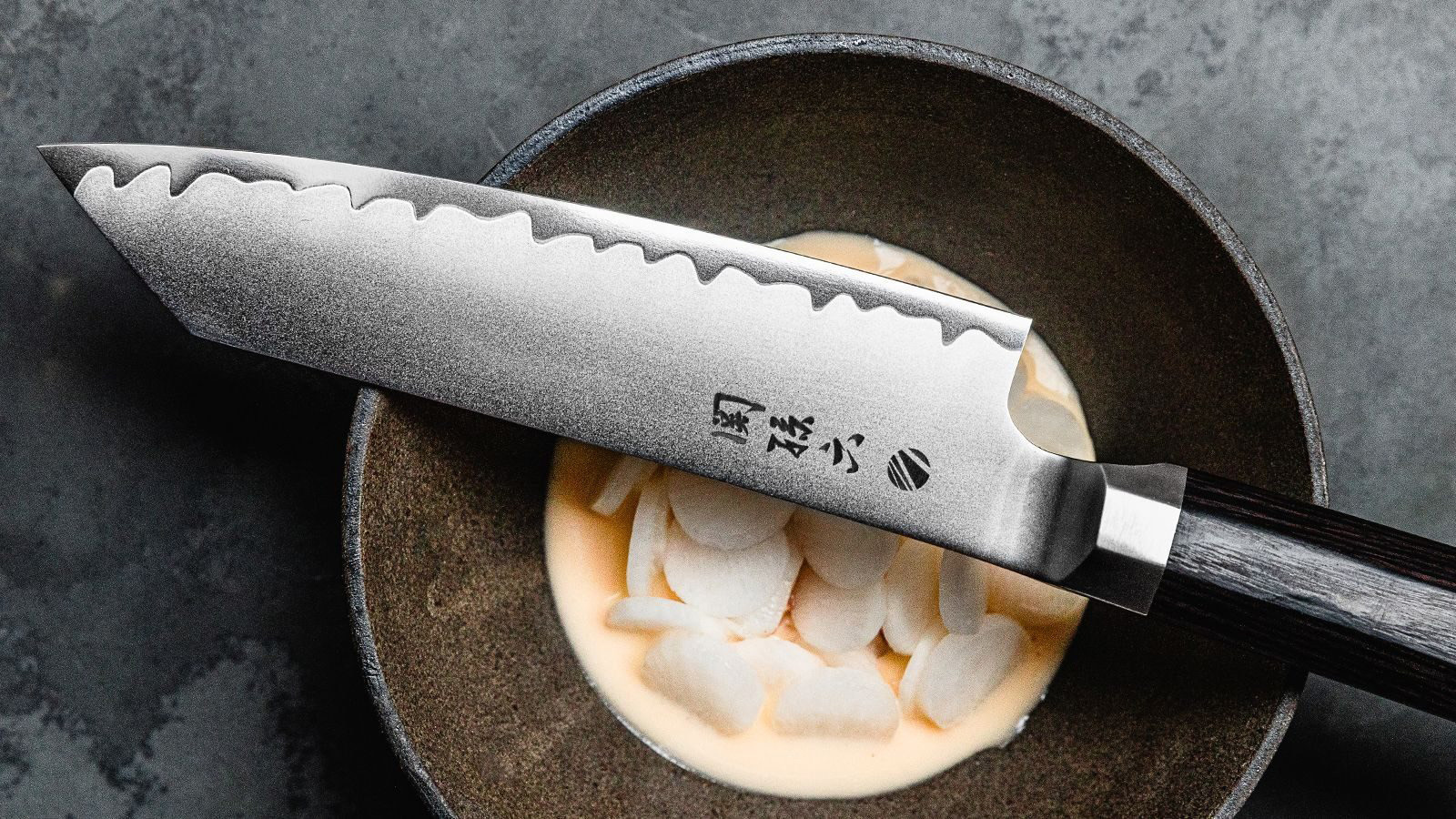
KAI
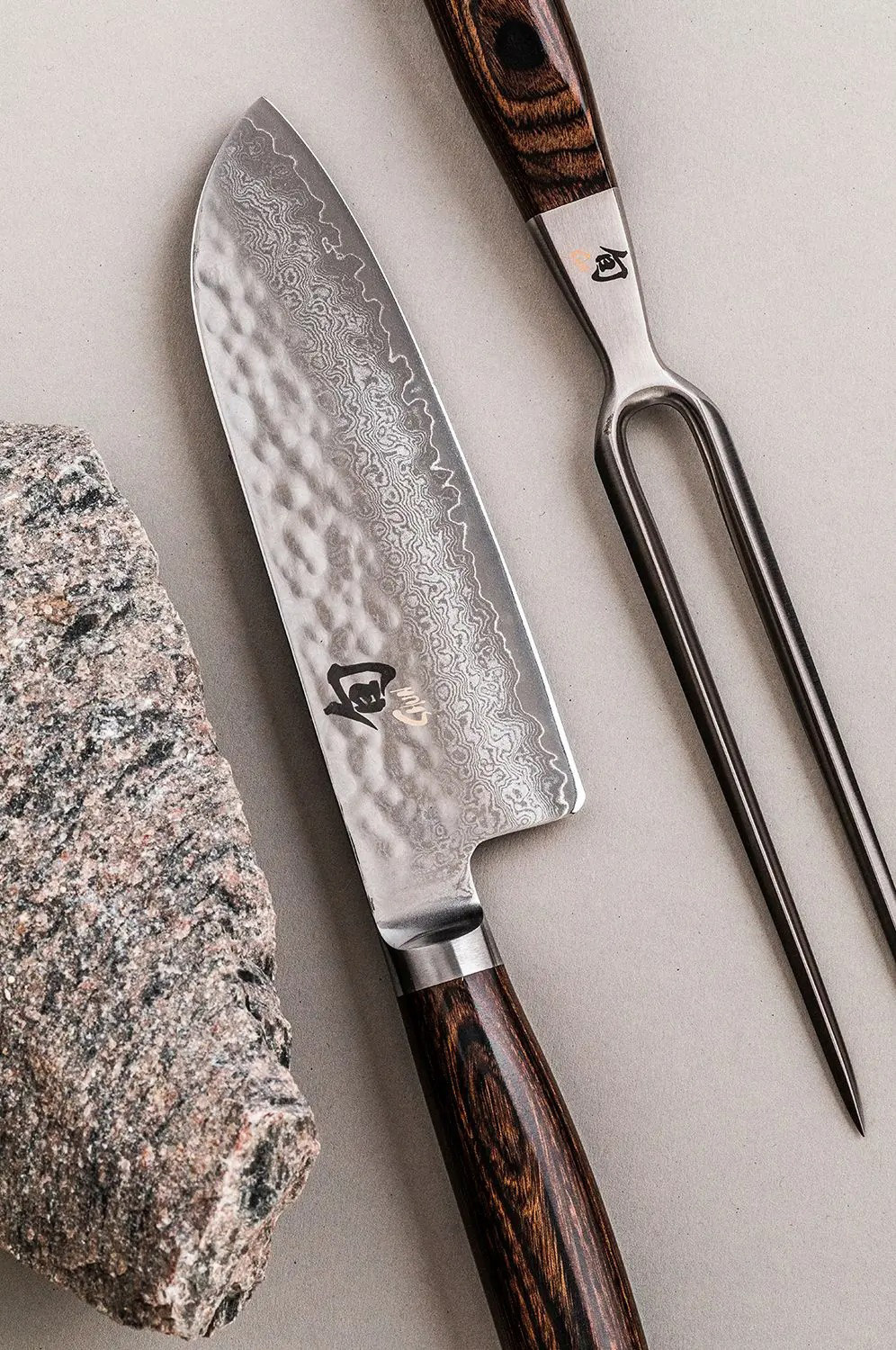
There is a moment, the first time you use a truly great knife, when something quietly clicks. The blade falls through an onion as if the onion had agreed to it in advance. The cut surface is so clean it looks polished. You slow down, not because you have to, but because you want to feel it happen again. That moment is what the Japanese company KAI has spent more than a hundred years trying to put into your hands, and what the city it comes from has been chasing for the better part of a thousand.
This is the story of how a town of swordsmiths became the beating heart of the world's finest kitchen cutlery, how a single folding knife built a global company, and why a Shun blade on your counter is, in a very real sense, a descendant of a samurai sword.
Seki: The City of Blades
To understand KAI, you first have to understand Seki, a modest city of around 80,000 people in Gifu Prefecture, roughly 40 kilometers north of Nagoya in the geographic center of Japan. Seki does not look like a legend. It looks like a quiet Japanese town. But it sits in the company of only two other places on earth, Solingen in Germany and Sheffield in England, as one of the three great cutlery capitals of the world.
Its story begins around 800 years ago, during the Kamakura period, when a swordsmith from Yamato Province (modern Nara) moved to the area and set up a workshop. He had not chosen Seki by accident. The region offered everything a bladesmith dreams of: clean, fast-flowing water from the Nagara and Tsubo rivers for quenching and tempering, abundant pine and hardwood for charcoal to feed the forge, and quality clay and soil for the crucibles and molds. Iron sand of exceptional purity was carried in from Yasugi in distant Shimane Prefecture. Nature had laid out a forge, and craftsmen came to light it.
What grew there became known as the Mino tradition, or Mino-den, one of the five great schools of Japanese sword making. Mino blades earned a reputation that is still repeated in Seki today: tough, resilient, and superbly sharp. For a warrior whose life depended on his sword, no higher praise existed. By the Muromachi period, more than 300 swordsmiths were working in Seki, and the town became one of Japan's principal producers of blades for an age defined by war.
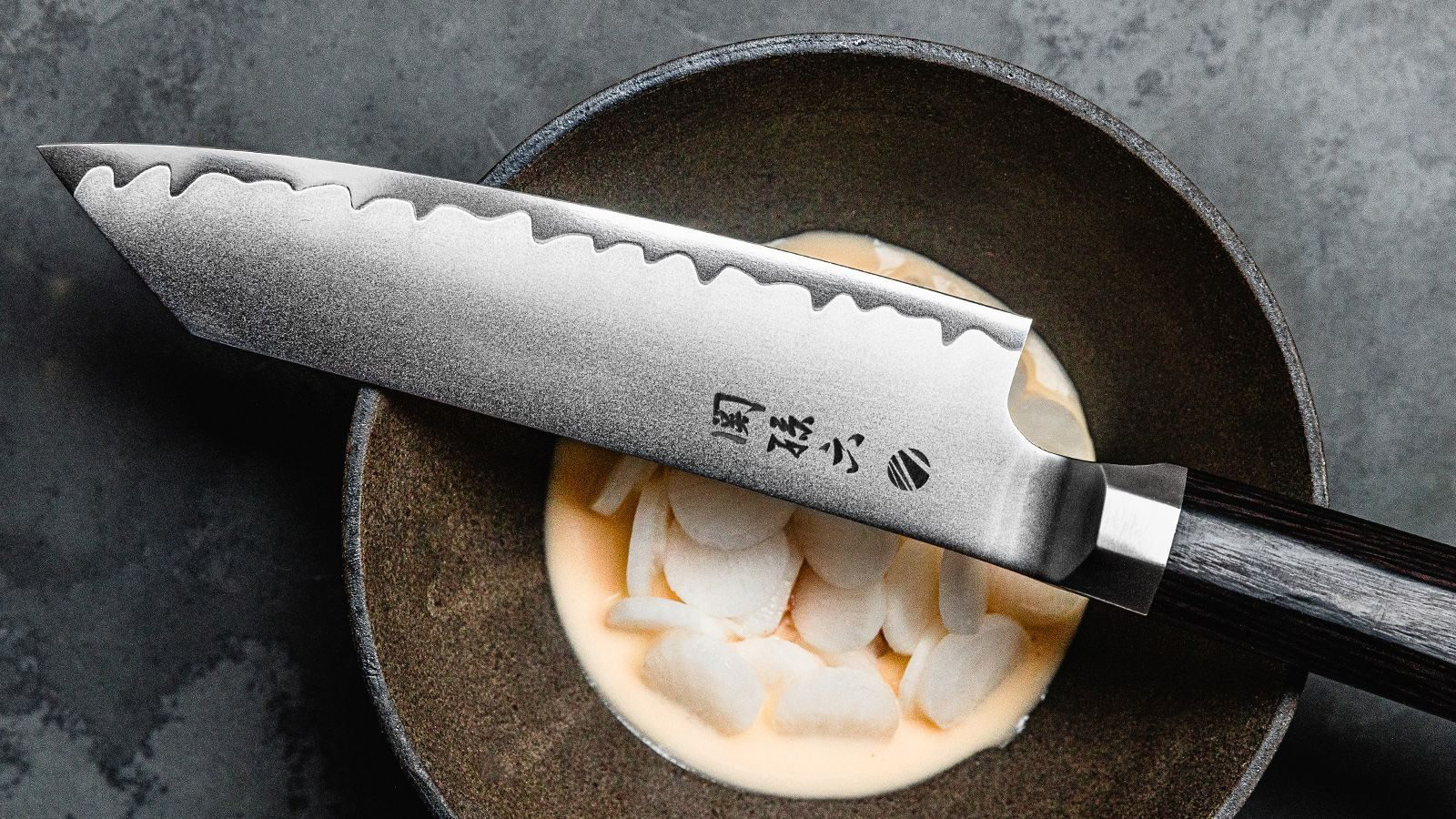
Eight hundred years of craft, distilled into a single, perfect edge.
The Swordsmith Behind the Name: Magoroku Kanemoto
Out of those hundreds of smiths, a few names rose into legend. The greatest of them, and the one whose name KAI still carries on its kitchen knives, was Magoroku Kanemoto, the second-generation master to hold the Kanemoto name. Because he lived and worked in Seki, people called him Seki no Magoroku, Magoroku of Seki.
His blades were not merely beautiful. They were terrifyingly effective. Kanemoto perfected a distinctive temper line, the sanbonsugi or "three cedars" pattern, that rippled across the steel like a row of mountain peaks, and his swords ranked among the Saijo O-wazamono, the very highest official Edo-period grade for cutting ability. The warlords of Japan's age of unification prized them. Tradition holds that swords by Magoroku passed through the hands of figures as towering as Oda Nobunaga, and that a Magoroku blade was given as a wedding gift when the daimyo Saito Dosan married his daughter to Nobunaga.
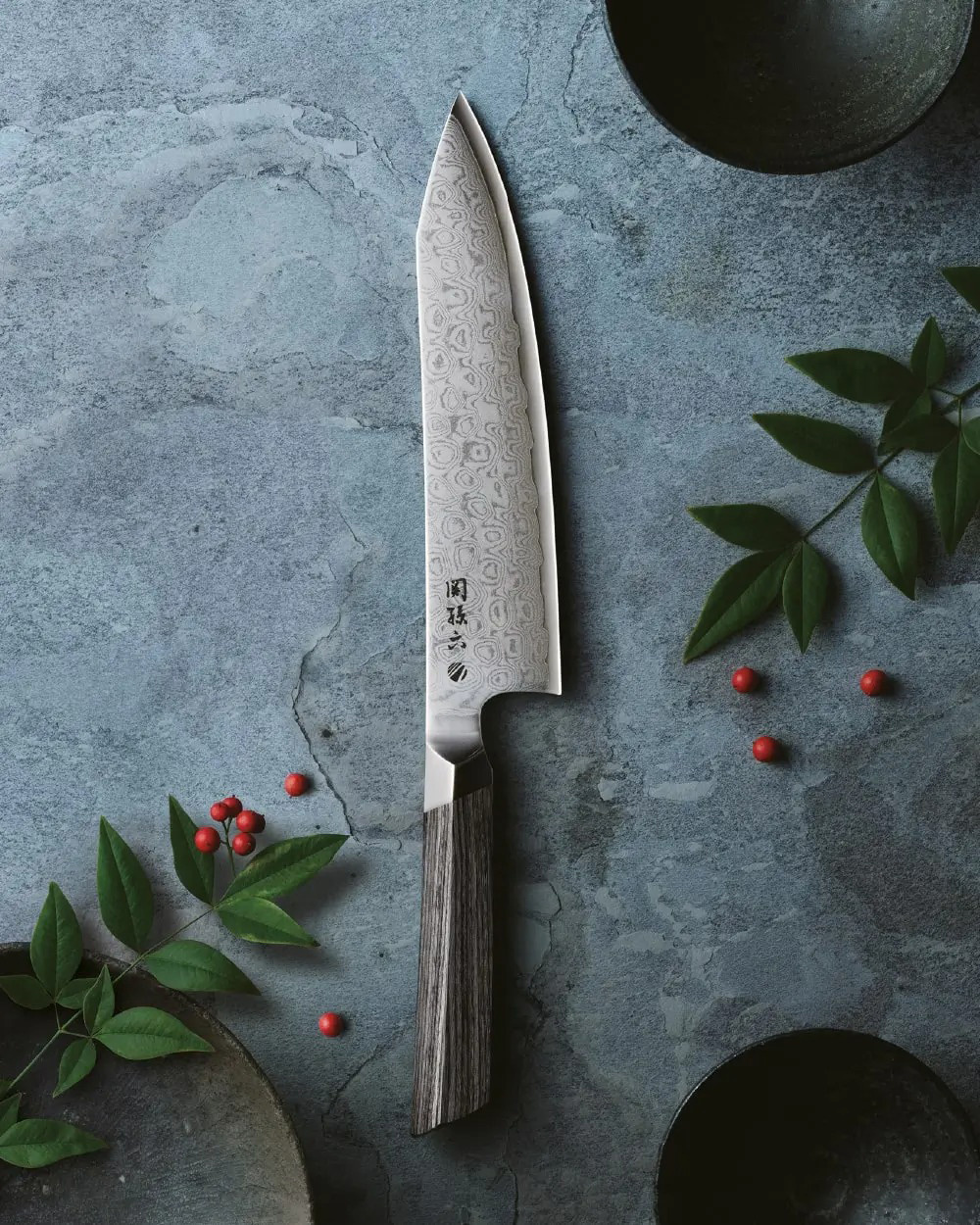
When you read the name Seki Magoroku stamped into a modern KAI knife, that is the lineage it salutes. It is a deliberate promise: the soul of the old masters, carried forward in steel you can hold today.
From Sword to Supper Table
History, of course, intervened. In the Meiji era, as Japan modernized and the samurai class dissolved, the wearing and making of swords was banned. For a town built on swords, this could have been the end. Instead, Seki's smiths did what great craftspeople always do. They turned their skill toward new purposes. The same hands that had forged katana began making the tools of everyday life: kitchen knives, scissors, razors, and pocketknives. The discipline did not disappear. It simply changed its target.
It was into this world, in 1908, that a young man named Saijiro Endo founded the workshop that would become KAI.
1908: One Man, One Folding Knife
Saijiro Endo started with almost nothing. He worked by the light of oil lamps, slept only a few hours a night, and employed just a handful of workers. His wife worried over his health while he poured himself entirely into the craft. The early years were brutal, and a postwar recession after the First World War nearly undid him. But Endo refused to stop improving.
His breakthrough was a single, almost humble object: the No.510 folding knife, a simple black-handled pocketknife. It was so well made, and so good, that it was copied endlessly by competitors, the surest sign of success in any craft. On the strength of it, Endo's company was eventually recognized as the number one knife producer in Japan.
He did not rest there. Importing German machinery and teaching himself an entirely new discipline, Endo developed Japan's first replaceable-blade safety razor, establishing the Seki Safety Razor company in 1932. By the late 1930s his razors were tucked into soldiers' care packages and used in households across the country. He was a marketer as well as a maker, handing out razor-shaped sugar cookies and monogrammed teacups to spread the brand. The company would later pioneer the disposable razor in Japan as well.
In 1947 the firm registered its first trademark, the Kaijirushi mark, founded on a simple principle: good quality, guaranteed under our own name. That word, Kai, would become the company's identity.
The KAI Group Today: A Family Empire of Blades
More than 115 years later, KAI is still a family company, run by the Endo line into its third and fourth generations. It has grown into one of the largest blade manufacturers on earth, producing over 10,000 different products and distributing them worldwide. Its catalog is staggering in range: fine kitchen cutlery, pocketknives, professional and beauty scissors, nail clippers, and an entire division of precision surgical and medical instruments. The same obsession with the edge that once armed samurai now equips operating theaters.
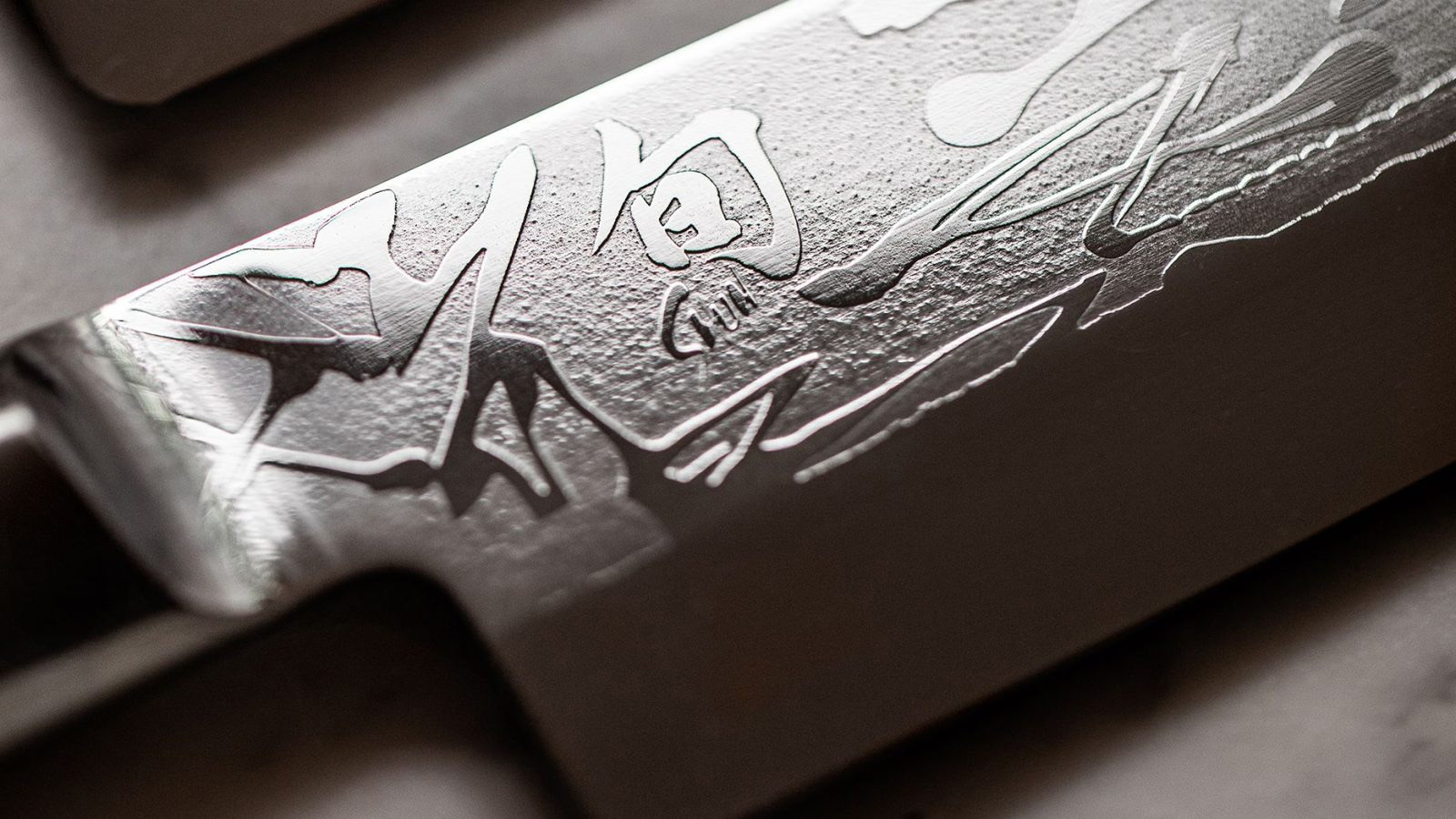
That heritage has earned rare recognition. KAI was honored with the Leonardo da Vinci Award from the Henokiens, the international association of family-owned businesses that have operated for more than two centuries, a club that prizes exactly the kind of patient, generational mastery Seki embodies. Yet for all its scale, KAI has never abandoned its hometown. Its finest kitchen knives are still made in Seki, by hand.
Seki Magoroku and Shun: Two Names, One Heritage
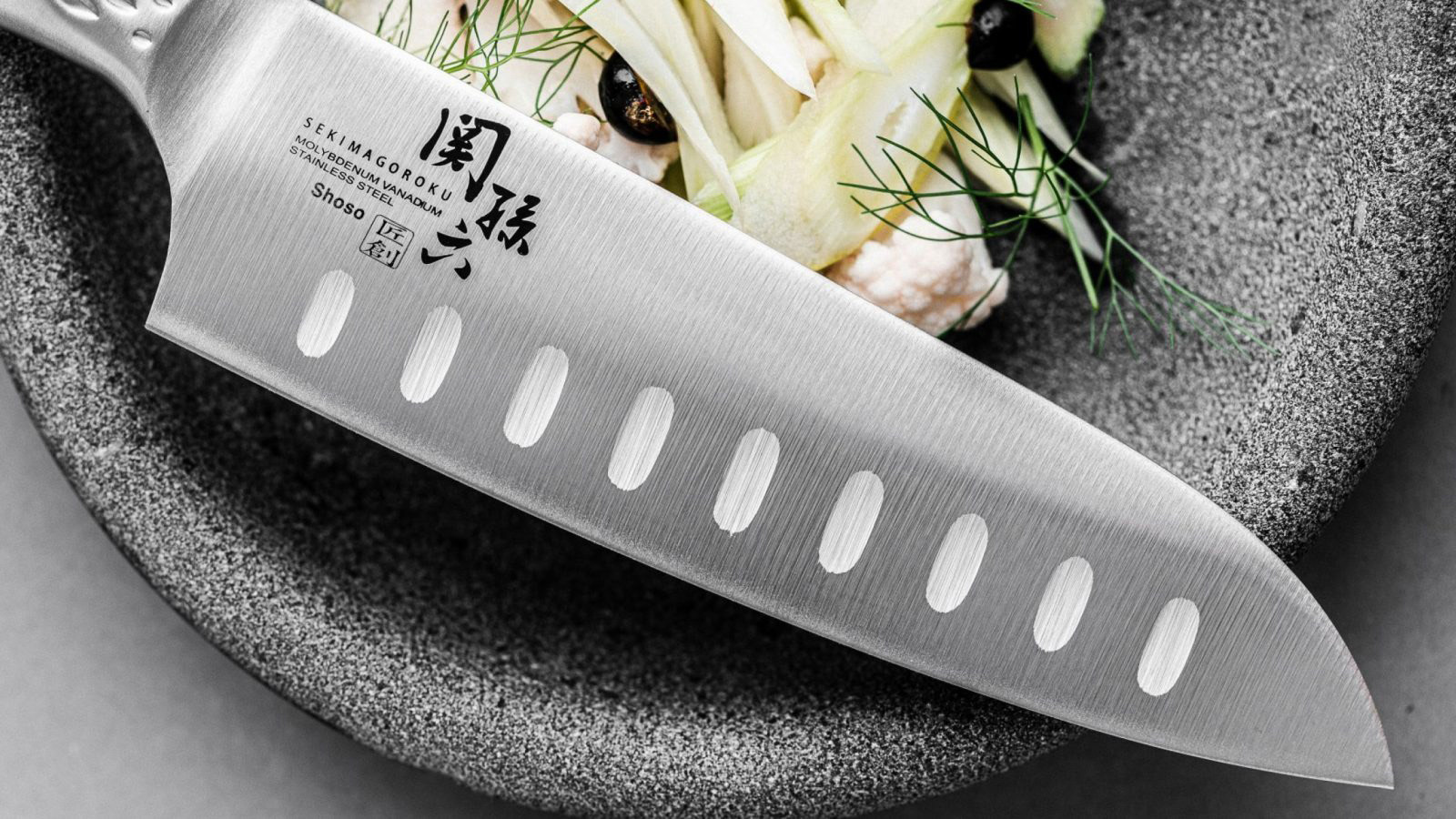
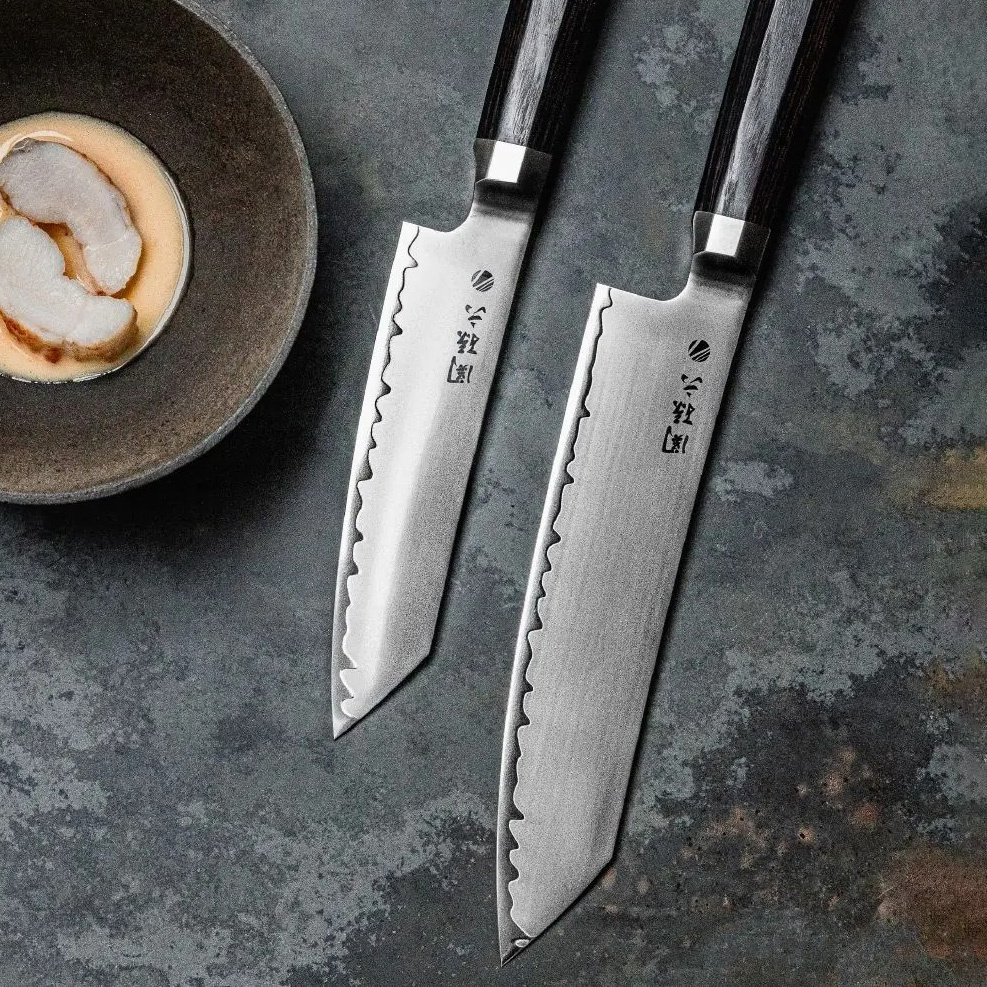
For the kitchen, KAI's craftsmanship reaches you under two great names. Seki Magoroku, named for the swordsmith himself, fuses the heritage and spirit of the old Mino masters with KAI's most modern metallurgy. These are knives built to be used hard for years, trusted, sharp, and honest.
The other name is more poetic. In Japanese, shun describes the precise moment in the year when an ingredient is at its absolute best: when the fruit is sweetest, the vegetable perfectly ripe, the fish at its peak. To cook with shun is to cook in harmony with the seasons, catching each food at the height of its perfection. KAI launched Shun for the wider market around the turn of the millennium, and the choice of name was a promise: a Shun knife is meant to be, always, at the peak of its own perfection. The brand became arguably the single most important force in bringing authentic Japanese kitchen knives to the global mainstream.
Every one of these knives is still handcrafted in Seki. Each passes through at least 100 individual steps, performed by highly skilled specialists in the direct tradition of the city's swordsmiths. It is less manufacturing than choreography.
The Science of the Edge: Steel That Holds
Here is where romance meets metallurgy, and where these knives genuinely earn their reputation.
At the core of the premium Shun blades sits a proprietary steel called VG-MAX (an evolution of the respected VG10), tuned with extra carbon for hardness and edge retention, plus cobalt, chromium, molybdenum, vanadium, and tungsten for strength, corrosion resistance, and durability. The result is a steel that can be hardened to around 61 on the Rockwell scale, considerably harder than a typical European knife.
Why does hardness matter? Because a harder steel can hold a far more acute edge without rolling or chipping. A classic German chef's knife is often ground to around 20 degrees per side. A Shun chef's blade is sharpened to roughly 16 degrees per side, a noticeably finer, keener angle. That is the difference between pushing through a tomato and gliding through it. The steel takes a screaming-sharp edge, and just as importantly, it keeps it.
Not every KAI knife is built the same way, and that is precisely the point: the range is matched to the task. The premium Shun lines are built around that VG-MAX or VG10 core. The traditional single-bevel blades, ground on one side in the classic Japanese manner, are made from robust high-carbon stainless steel. Several Seki Magoroku series use a tough German stainless steel (X50CrMoV15) prized for durability and easy upkeep. Different steel for different hands, all of it beautifully sharp.
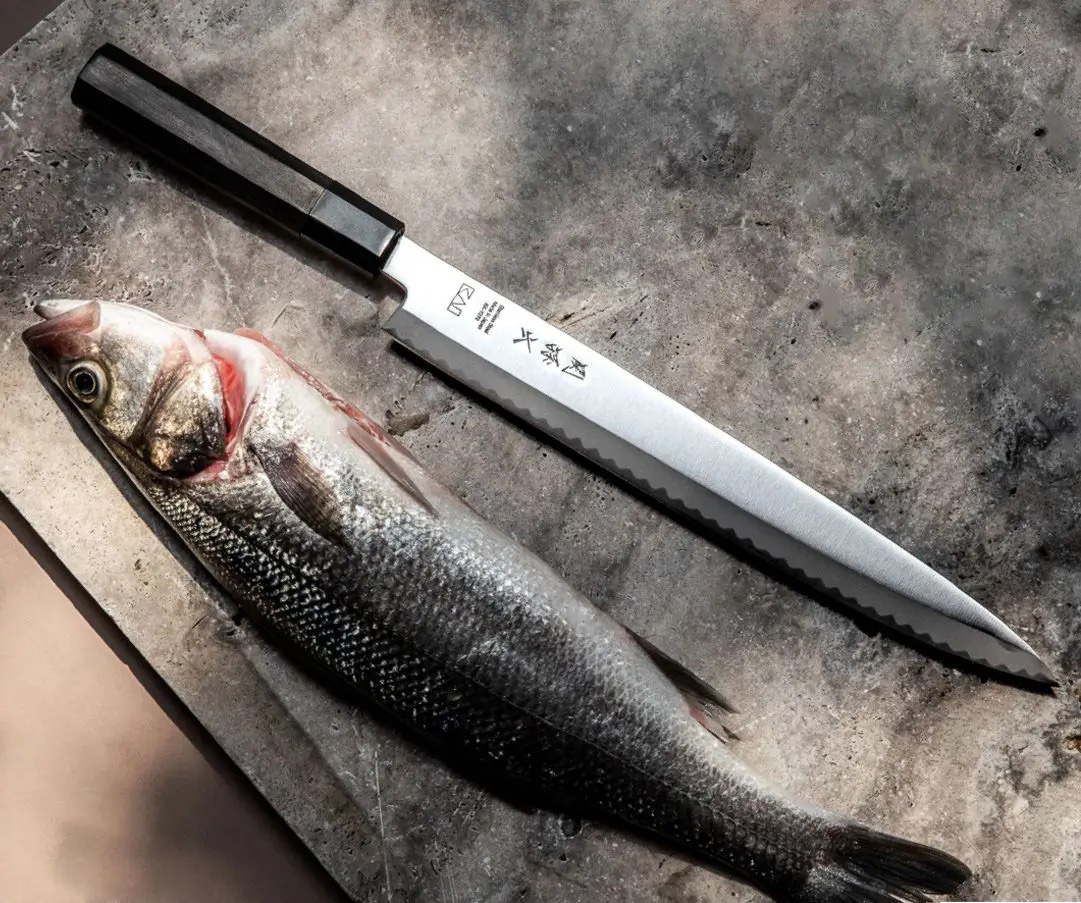
The Art of Damascus: Layers With a Reason
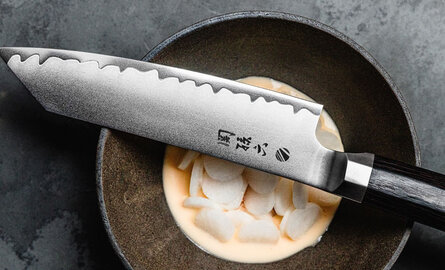
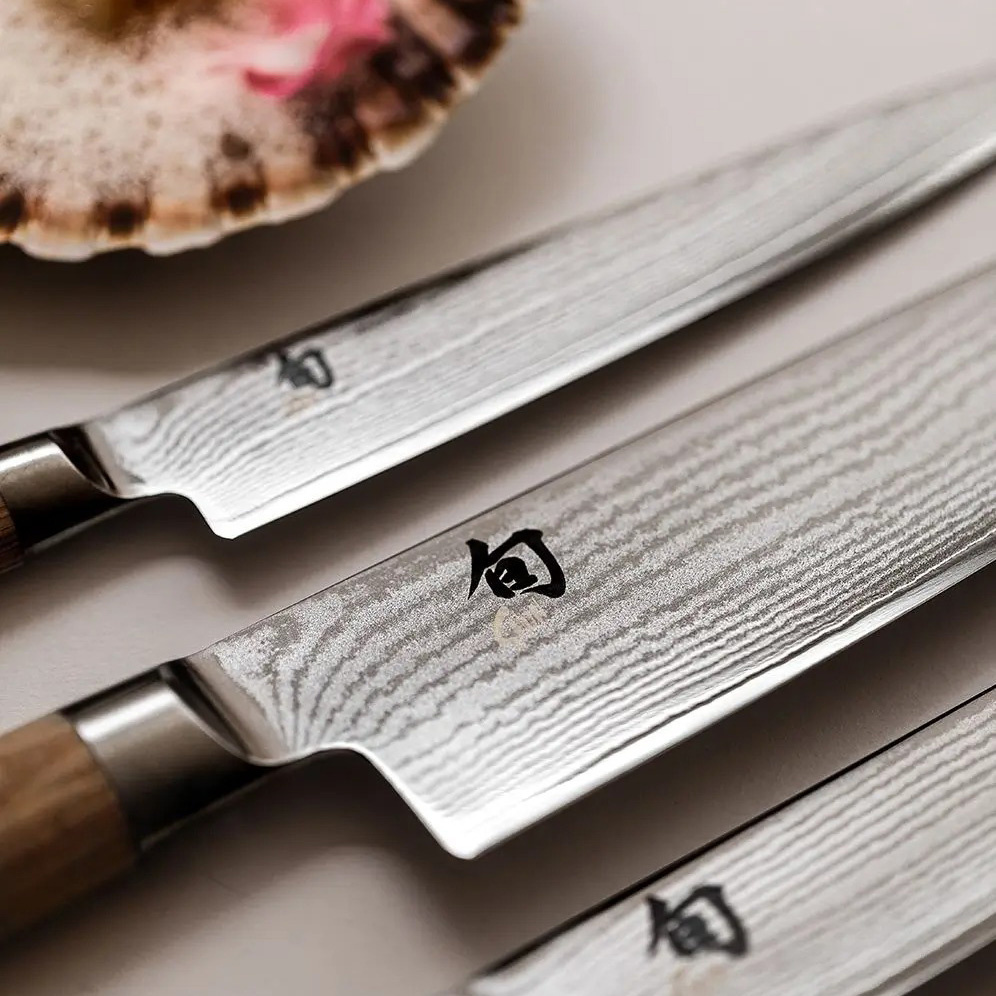
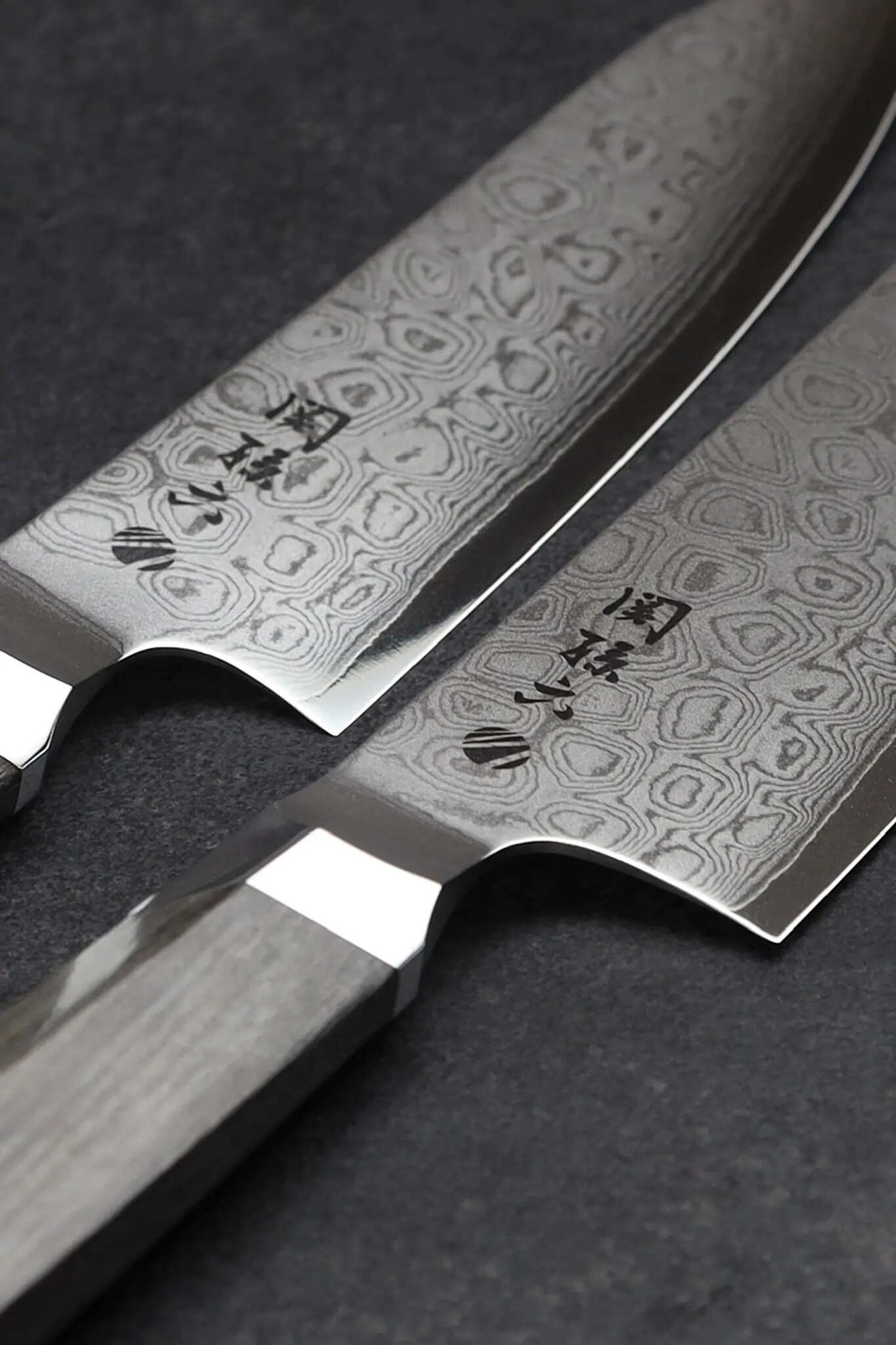
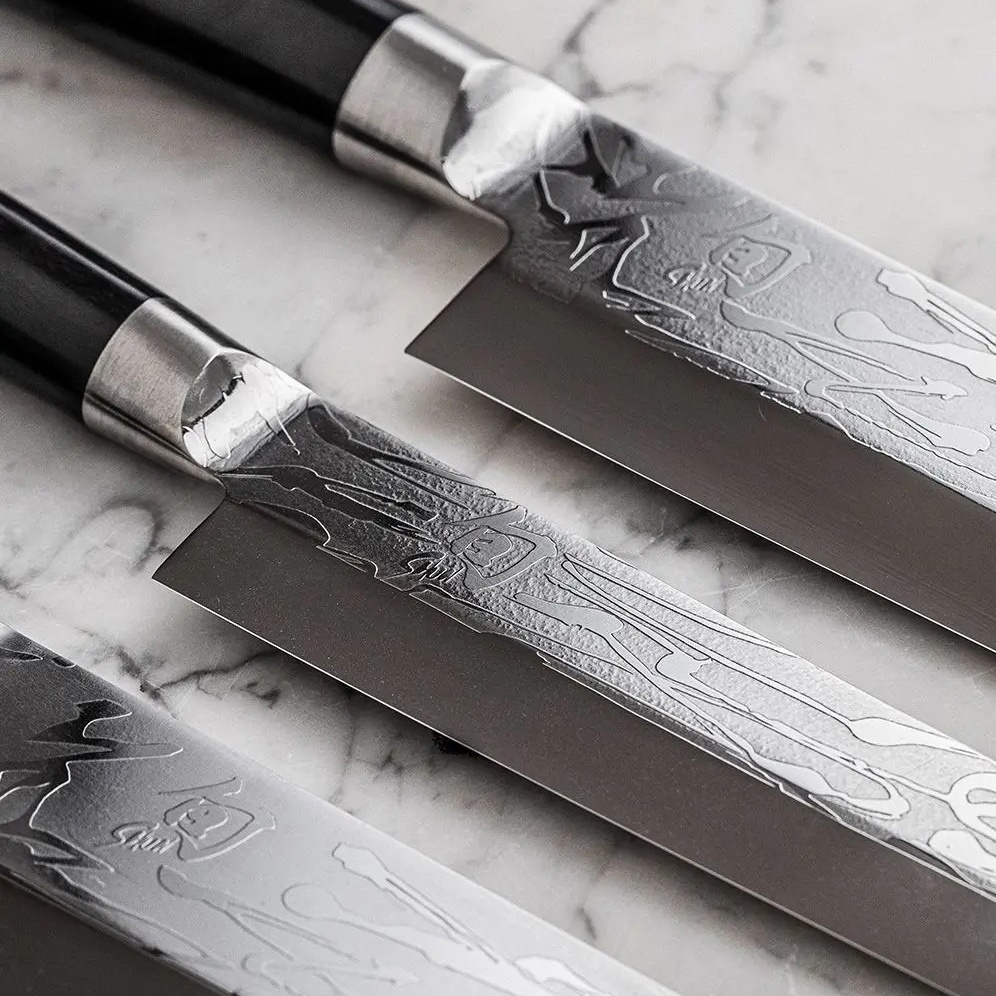
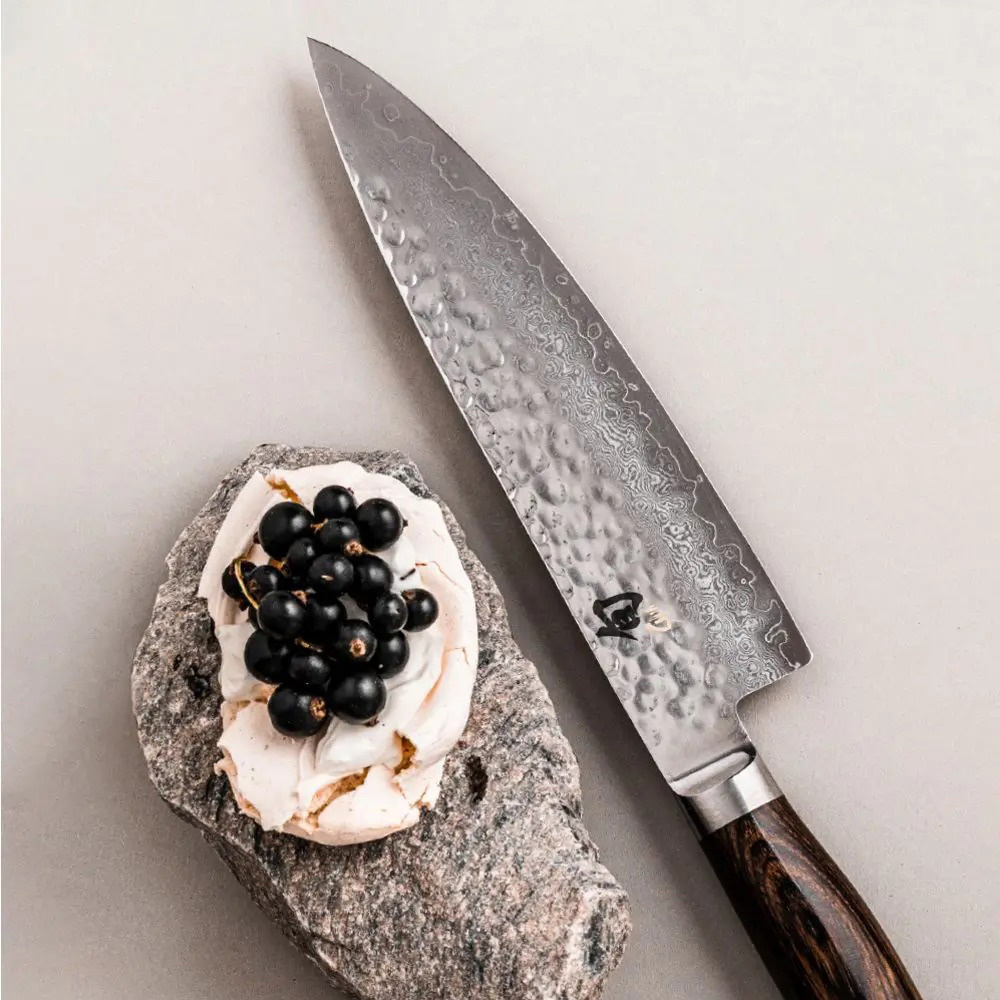
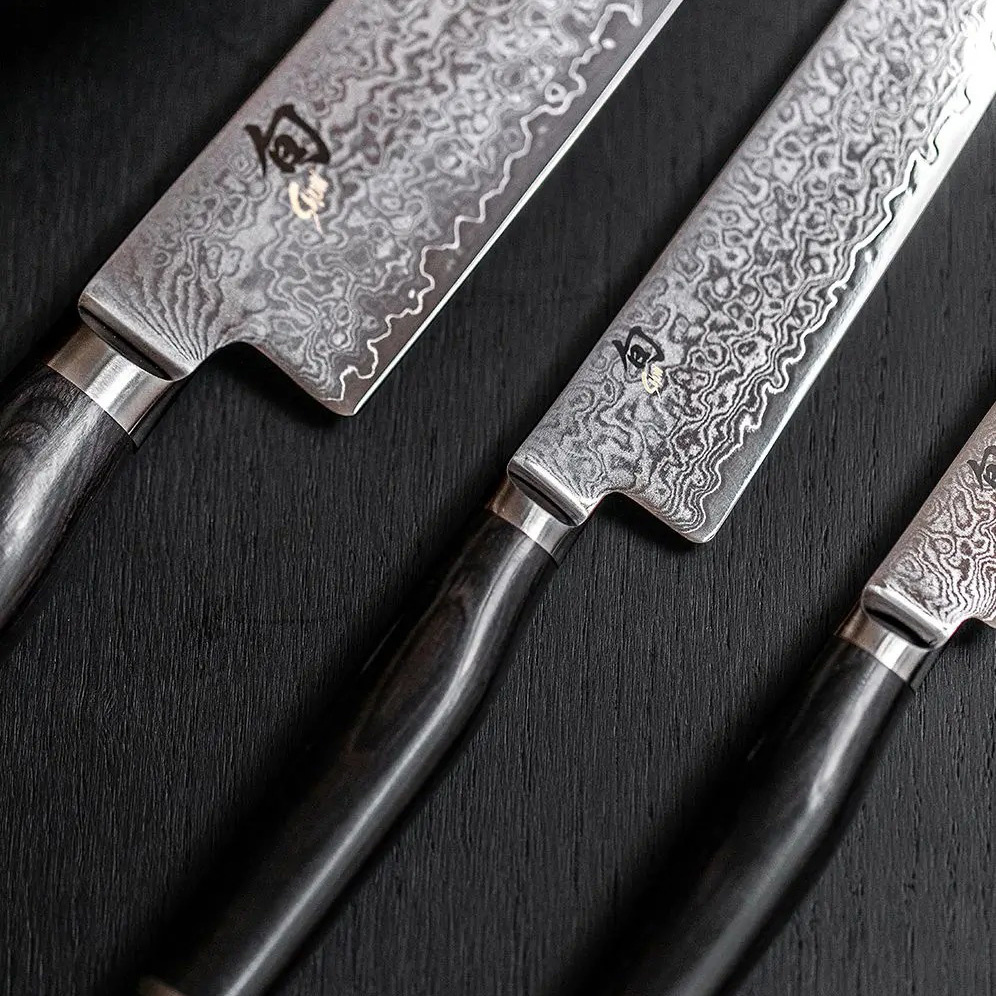
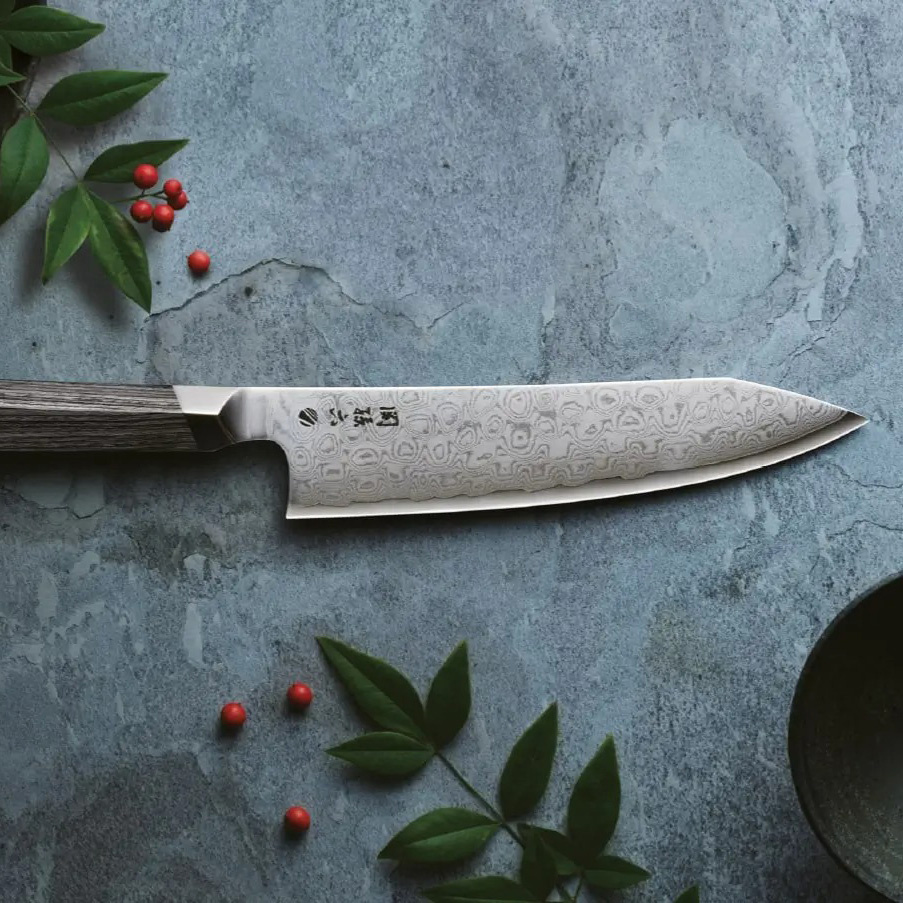
Pick up a Shun Classic and the first thing you notice is the blade's surface: a flowing, rippling, watery pattern that looks like wind on a pond. This is Damascus cladding, and it is not just decoration, though it is undeniably gorgeous.
The technique works like this. The hard cutting core, the part that actually does the work, is sandwiched between many layers of softer stainless steel, traditionally 34 on each side. The hard core gives a razor edge and superb retention. The softer outer layers add flexibility and toughness, protecting that brittle, ultra-hard core from cracking under stress. It is the same logic the old swordsmiths used to make a katana that could take an edge yet survive a battle: marry hard steel to soft steel and get the best of both.
KAI then bead-blasts the finished blade, which both reveals the layered Damascus pattern and creates thousands of microscopic dimples across the steel. Those tiny air pockets reduce the surface area touching your food, so slices of potato or fish release from the blade instead of clinging to it.
The Shun Lines: Japanese Artistry at Its Peak
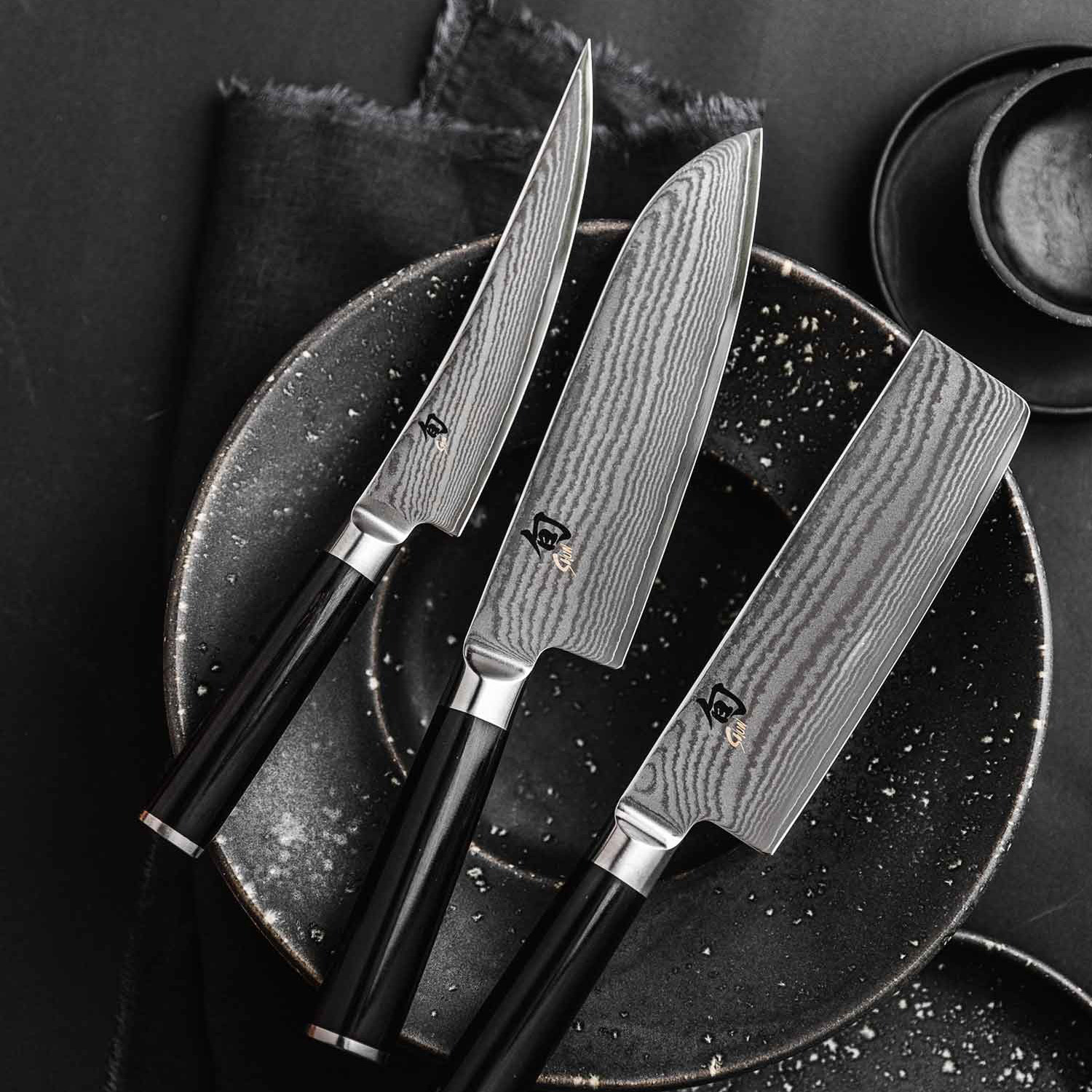
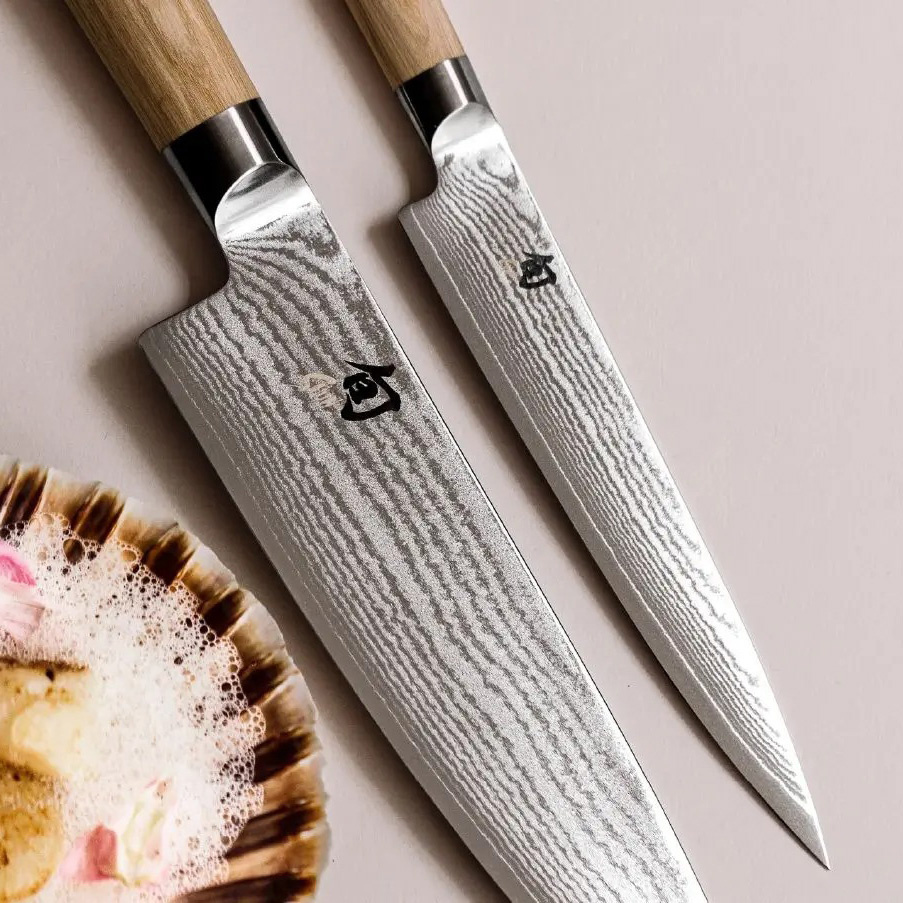
One of the joys of KAI is that there is a knife for every hand and every aesthetic. Here are the Shun lines we carry.
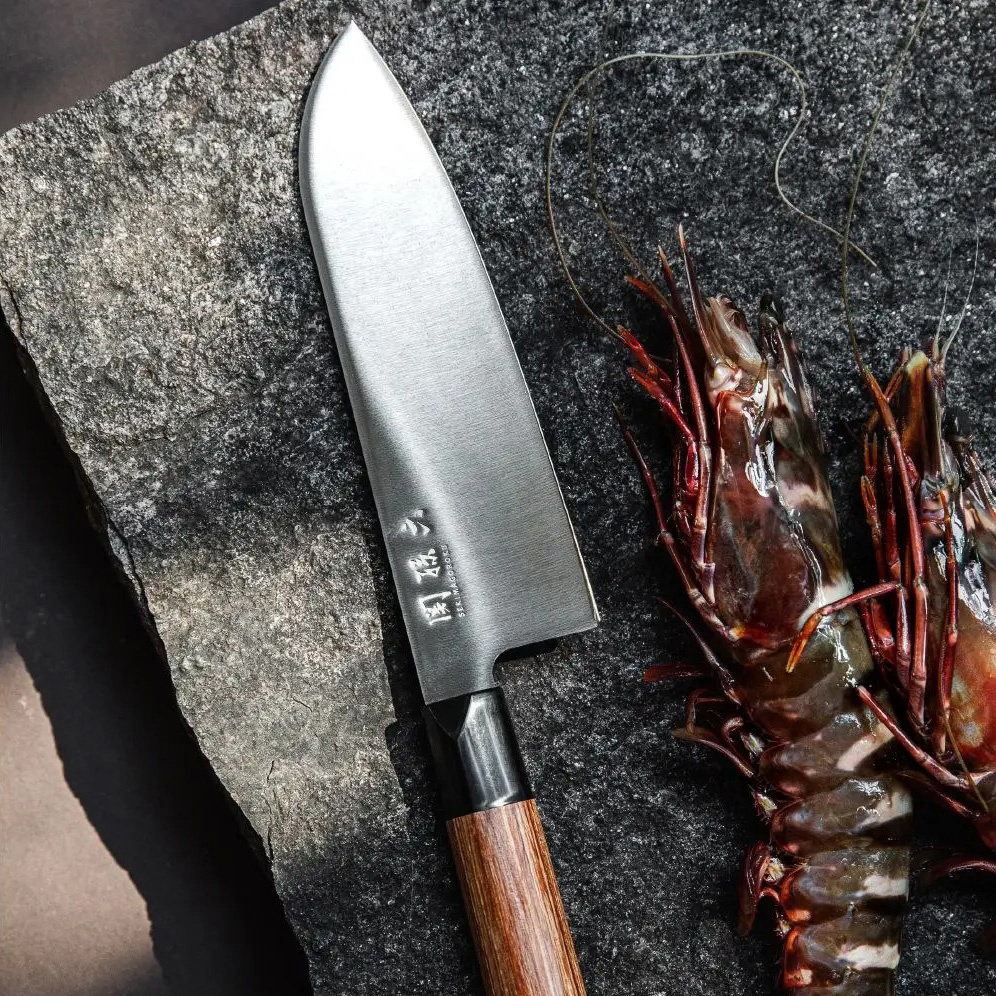
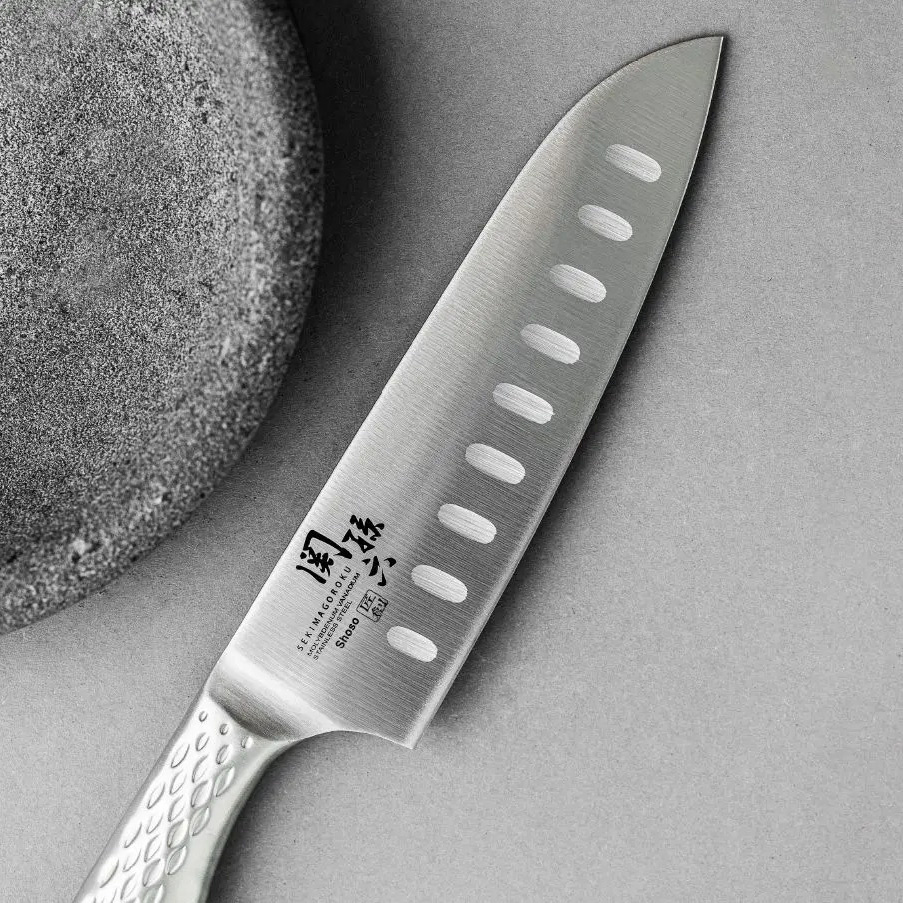
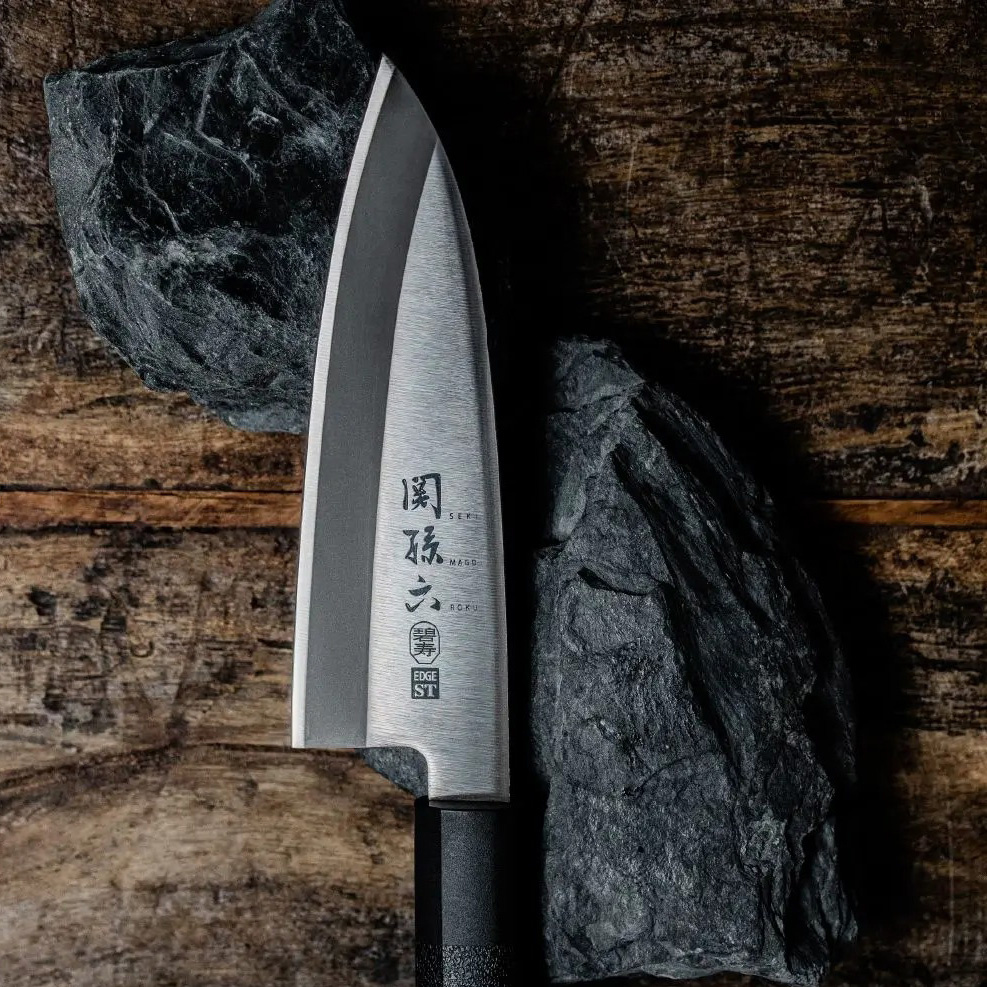
Seki Magoroku: The Swordsmith's Living Legacy
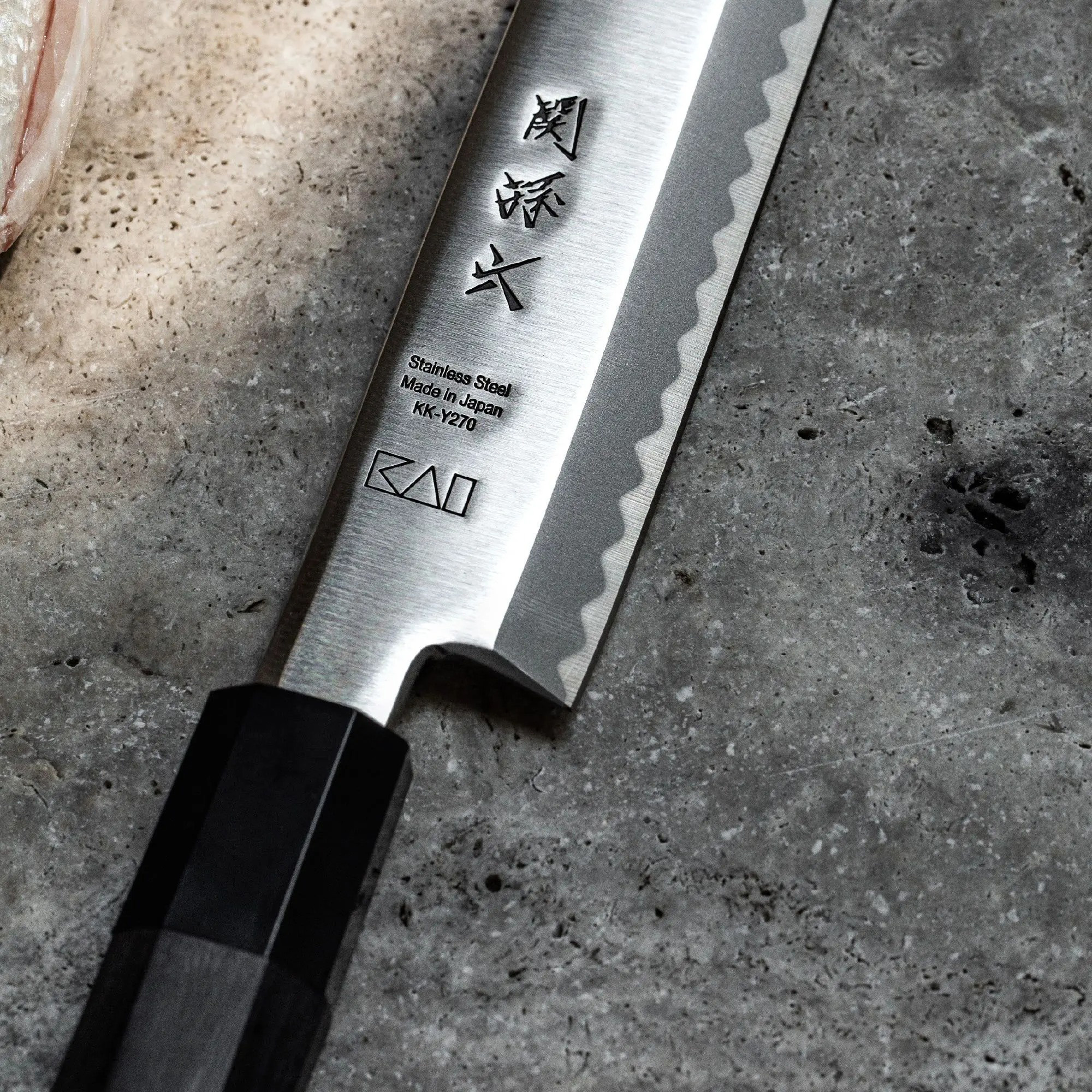
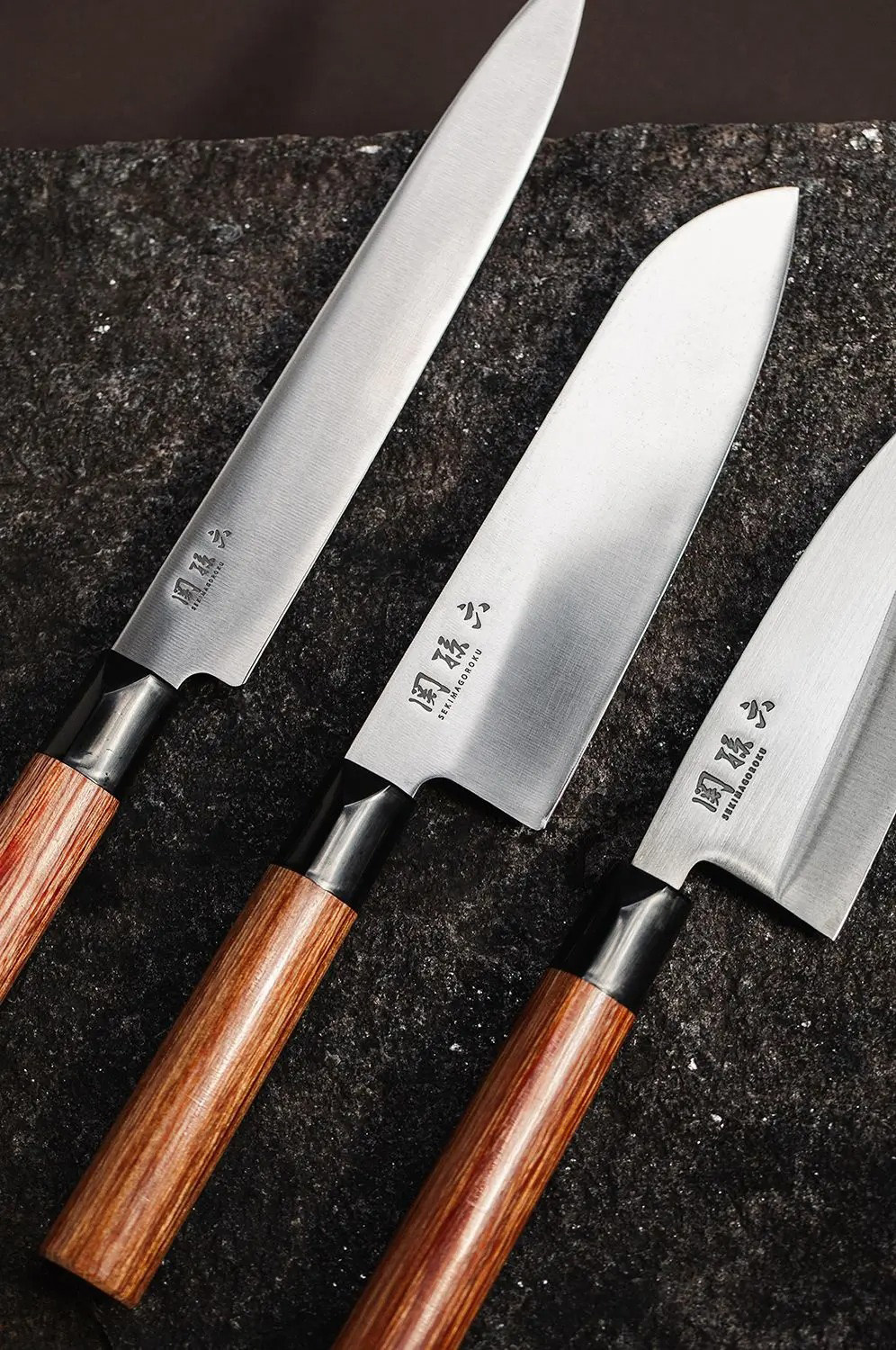
Where the Shun lines lean into artistry, the Seki Magoroku family carries the working spirit of the old masters straight to your board.
Wasabi Black: Your First Japanese Knife
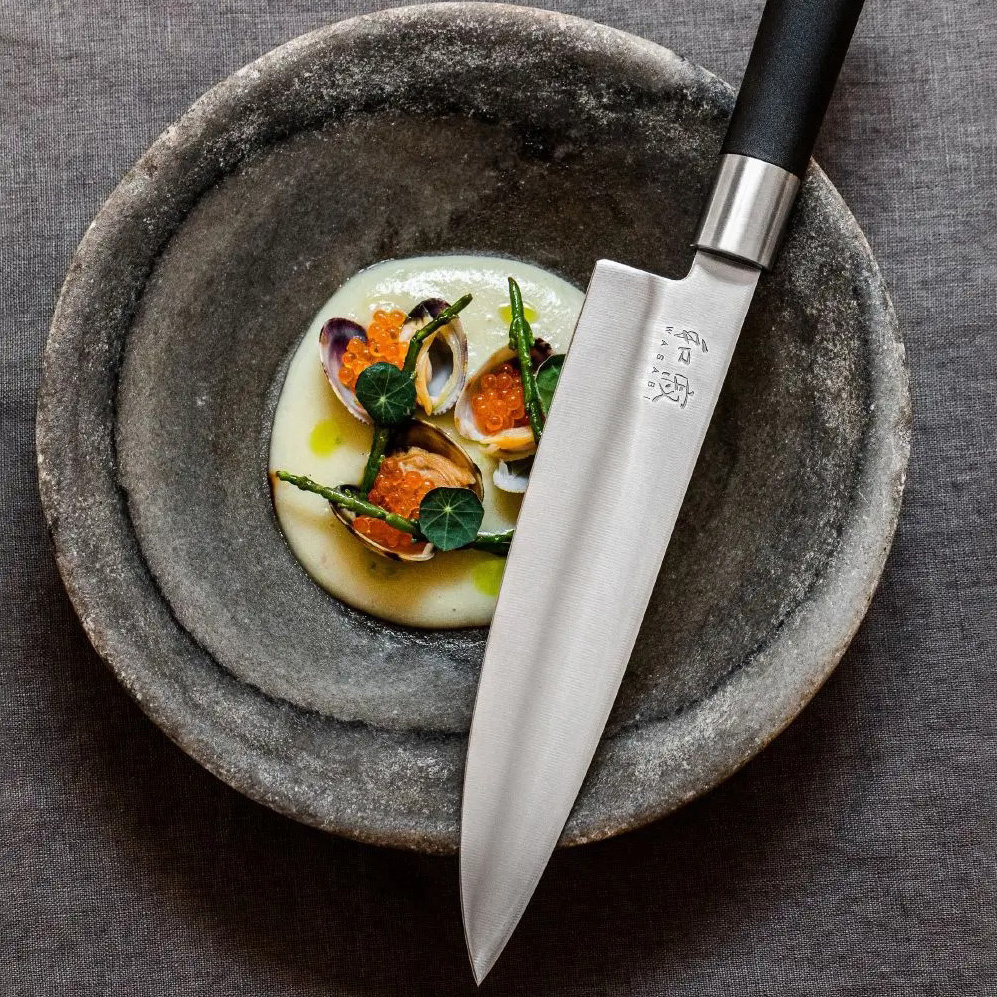
Not ready to commit to the top of the range? The Wasabi Black line is the easy way in. Reduced, modern, and refreshingly affordable, it delivers genuine Japanese sharpness and feel in a clean, no-fuss package. It is the perfect first Japanese knife, and a rather addictive one: plenty of cooks who start here come back for a Shun.
EXPLORELiving With Your Knife: How to Honor the Blade
A great knife is a partnership, and it rewards a little care with a lifetime of service. A few simple habits:
- Always hand wash and dry immediately.Never use the dishwasher, where heat, detergent, and jostling will ruin both edge and finish.
- Use a soft cutting surface.Wood (Japanese hinoki is ideal) or a soft poly board protects that fine edge. Avoid glass, stone, and steel.
- Respect what it is for.These are precision instruments for produce, proteins, and prep, not cleavers. Keep them away from bones and frozen food.
- Cut, do not crush.Use a smooth forward-and-back slicing motion rather than chopping straight down, and let the sharpness do the work.
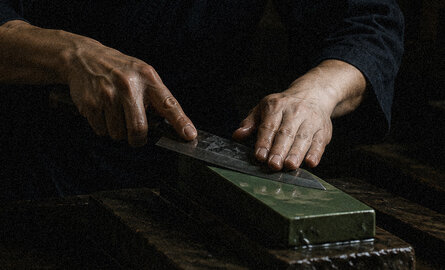
- Hone regularly, sharpen occasionally.A few passes on a honing steel or a KAI whetstone keeps the edge true, and a well-kept blade stays beautifully sharp for years.
A Blade Worth Keeping
When you set a KAI knife on your counter, you are holding the latest expression of an unbroken thread that runs back through Saijiro Endo's oil-lit workshop, past the Meiji ban that turned swordsmiths into knifemakers, all the way to Magoroku Kanemoto hammering battle-ready steel for the warlords of a divided Japan. Eight hundred years of obsession with a single question, how to make something cut perfectly and last, are concentrated in that one tool.
It is, in the truest sense, a functional work of art. And the best way to honor a work of art like this is not to admire it behind glass. It is to pick it up, feel that first clean cut, and cook.
Explore the KAI collection