 Frying pans & Sauté pans
 Non-stick
 Stainless steel
 Carbon steel
 Cast iron
 Cooking pots
 Demeyere Silver
 Scanpan Impact
 Scanpan Fusion 5
 Silampos Supreme Pro
 Silampos Grand Hotel
 Stellar Profile
 Stellar Equinox
 Stellar Eclipse
 Habonne Royal
 Korkmaz Proline
 Korkmaz Perla
 Sauteuses
 Dutch ovens
 Chasseur
 Lava
Lava Victoria
 Other
Other Grills & Grill pans
 Woks
Woks Carbon steel & cast iron
 Stainless steel
 Non-stick
 Kettles
 Fondue
 Tajines
 Pressure cookers
 Smoking pans
 Poffertjes pans
 Lids
Lids Splatter screens
 Miscellaneous
 Paella
 Japanese knives
 Kai Shun Classic
 Kai Shun Classic White
 Kai Shun Premier
 Kai Shun Premier Minamo
 Kai Shun Pro Sho
 Kai Kinju & Hekiju
 Kai Seki Magoroku KK Yanagiba
 Kai Seki Magoroku Kaname
 Seki Magoroku Migaki
 Kai Seki Magoroku Redwood
 Kai Seki Magoroku Shoso
 Kai Wasabi Black
 Kai Specialties
 Miyabi 7000 D
 Miyabi 4000 FC
 Miyabi 800 DP
 Miyabi 6000 MCT
 Miyabi 5000 MCD
 German knives
 Wüsthof Classic
 Wüsthof Classic Ikon
 Wüsthof Ikon
 Wüsthof Epicure
 Wüsthof Gourmet
 Burgvogel Oliva
 Robert Herder
 French knives
 Elephant ****Sabatier forged stainless steel pakkawood
 Elephant ****Sabatier forged stainless steel olivewood
 Elephant ****Sabatier forged carbon steel pakkawood
 Elephant ****Sabatier forged carbon steel olivewood
 Elephant ****Sabatier stamped stainless steel
 Laguiole en Aubrac Gourmet
 Laguiole en Aubrac Classique
 Pallares Solsona
 Carbon steel kitchen knives
 Stainless steel kitchen knives
 Cleavers
 Steak knives
 Folding knives
 Steak knives
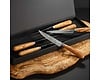 Pallares Solsona
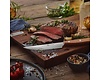 Wüsthof
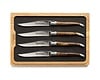 Laguiole en Aubrac
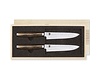 Kai / Shun
 Saladini
 Laguiole Style de Vie
 Other
Other Honing and sharpening
 Naniwa Chosera Pro
 Naniwa Advance
 Naniwa Standard
 Other whetstones
 Sharpening rods
 Honing steels
 Knife sharpeners
 Accessories
 Accessories
 Knife guards
 Knife magnets
 Knife blocks
 Knife bags
 Bread knives
 Cleavers
 Knife sets
 Simple kitchen knives
 Folding knives
 Victorinox
 Spyderco
 Böker
Böker Coutellerie G.R.
  Laguiole en Aubrac
 Nontron
 Opinel
 Cheese knives
 Oyster knives
 Miscellaneous
 Stellar Poise
 Graters, shavers, mandolines
 Mandolines
 Microplane Master
 Microplane Premium Classic
 Microplane Gourmet
 Microplane Professional
 Other Microplanes
 Other
Other Silicone tools
 Whisks
 Strainers & Colanders
 Spatulas
 Stainless steel
 Silicone
 Wood & Pressed wood
 Plastic
 Mortars & Pestles
 Tongs & Tweezers
 Kitchen shears
 Garlic presses
 Mills & Grinders
 Peugeot Paris
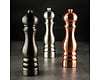 Peugeot Paris Chef
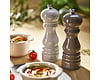 Peugeot ParisRama
 Peugeot Paris Rouge Passion
 Peugeot various
 Zassenhaus
 Brushes
 Ladles & Serving spoons
 Nutcrackers
 Peelers
 Oyster, lobster, snail
 Mashers
 Skimmers / frying scoops
 Funnels
 Ice cream scoops
 Pizza shovels & Pizza stones
 Can openers
 Squeeze bottles
 Meat mallets
 Skewers
 Miscellaneous kitchen aids
 Tortilla presses
 Citrus presses
 Baking tins & molds
 Springform pans
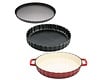 Quiche & flan tins
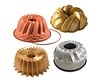 Bundt pans
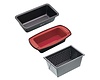 Cake & bread tins
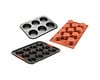 Muffin trays
 Madeleines, savarins, angel food
 Non-stick
 (Anodized) aluminum
 Silicone
 Cast aluminum
 Ceramic
 Baking trays
 Pastry rings
 Small baking molds
 Baking cups
 Paper Panettone molds
 Chocolate
 Polycarbonate molds
 Silicone molds
 Miscellaneous chocolate tools
 Chocolate food coloring
 Chocolate
 Books
Books (Cookie) cutters
 Cutter sets
 Cookie cutter sets
 Individual cookie cutters
 Piping bags & nozzles
 Sets
Sets Piping bags
 Round piping nozzles
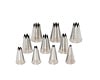 Star piping nozzles
 Miscellaneous
 Accessories
 Mixing bowls
 Rolling pins
 Bread
Bread Dough scrapers
 Palette knives
 Fondant tools
 Modeling tools
 Impression mats
 Smoothers, combs & spatulas
 Fondant cutters / modelers
 Mats, paper and foil
 Acetate foil
 Silicone mats
 Cooling racks
 Brushes
 Turntables
 Cake servers
 Cake cutters / knives
 Candles
 Cake boxes
 Cake drums
 Other
Other Food coloring | gel
 Food coloring | oil based
 Food coloring | liquid
 Food coloring | powder
 Color spray & Velvet spray
 Edible markers
 Flavors
 Patis Decor natural flavors
 Patis Decor flavors
 PME flavors
 Extracts
 Glitters & decorations
 Magic sparkles (glitter flakes)
 Lustre snow
 Sugar flowers and decorations
 Sprinkles
 Fondant, Marzipan & Icing
 Fondant
 Royal icing, lace, etc.
 Biscuit Icing
 Cake drips
 Misc. ingredients
 Sugars and sugar substitutes
 Gold and silver leaf
 Mixes
Mixes Ravioli stamps
 Ravioli molds
 Pasta wheels / rollers
 Rolling pins
 Pasta makers
 Various
 Peugeot Ceramics
 Rectangular
 Square
 Other
Other Casseroles
 Roasting trays
 Terrines
 Thermometers
 Measuring jugs
 Scales
 Kitchen timers
 Measuring cups & spoons
 Other
Other Japanese tableware
 Gift sets
 Bowls
Bowls Salad bowls
 Plates
 Chopsticks
 Chopstick rests
 Cutlery
 Stellar Rochester
 Stellar Sterling
 Stellar Winchester
 Stellar Raglan
 Salad bowls
 Salad servers
 Butter dishes
 Butter knives
 Heim Söhne spoons
 Trivets and coasters
 Glasses
 Serving trays
 Other
Other Percolators / moka pots
 Bialetti parts
 French presses
 Milk frothers
 Coffee grinders
 Tampers
 Espresso tools
 Milk jugs
 Coffee filters
 Tea
Tea  Teapots
 Wine tools
 Waiter's friends / corkscrews
 Decanters
 Wine coolers
 Other
Other Cocktail tools
 Misc. bar tools
 Aprons
 Kitchen towels
 Oven mitts & pot holders
 Other
Other Wood
Wood Plastic
 Pressed wood fiber
 Wood oil
 Pots & Pans
 Knives & accessories
 Kitchen aids
 Baking & pastry
 Edibles
 Pasta
Pasta Oven
Oven Measuring
 Tableware
 Coffee & Tea
 Bar & wine
 To go & storage
 Textiles
 Books
Books Boards
 Olivewood
Scanpan Black Iron
Scanpan Black Iron - carbon steel as the professional kitchen knows it
The Black Iron series is Scanpan's answer to one of the oldest and most proven materials in culinary history: carbon steel. While the brand is internationally best known for its patented non-stick aluminium pans, Black Iron represents an entirely different cooking philosophy - one where no coating determines cooking performance, but the material itself, the technique, and time.
Scanpan was founded in 1956 by the Brund family in Ryomgaard, a small town on the Djursland peninsula in Denmark. The company grew into one of the most respected Scandinavian kitchen brands in the world, exporting to more than 50 countries. All non-stick aluminium products are still cast at the factory in Ryomgaard - by hand, under 250 tonnes of pressure, from recycled aluminium. That Scandinavian design discipline - functional, timeless, uncompromising in quality - is also the foundation of the Black Iron series. But the material is fundamentally different.
The material: black carbon steel at 3 mm
The pans in the Black Iron series are made from black carbon steel, 3.0 mm thick. Carbon steel is an alloy of iron and carbon - typically 0.5 to 1.5% carbon - without the chromium addition that makes steel stainless. The result is a material with its own distinctive and valuable properties.
Heat conductivity and response
Carbon steel conducts heat quickly and responds immediately to changes in the heat source. This is the crucial difference from cast iron: cast iron retains heat for longer but responds slowly; carbon steel heat is directly controllable. For a cook who wants to switch between intense searing and delicate finishing, carbon steel is the ideal choice. The 3 mm thickness is a deliberate choice: thick enough for stable heat distribution and structural integrity, thin enough for fast response and ease of handling.
Maximum heat resistance
Carbon steel withstands very high temperatures - significantly higher than synthetic non-stick coatings. The Black Iron pans are suitable for use on all heat sources (including induction), in the oven, on the barbecue and over open fire. There is no upper limit to oven temperature. This makes the series particularly suited to techniques where extreme heat is essential: hard-searing meat for a perfect Maillard reaction, deglazing the pan, or finishing dishes in the oven that were started on the stovetop.
The patina - the living cooking surface
Carbon steel develops a patina with use: a layer of polymerized fat that bonds molecularly to the steel surface. This is not a chemical coating but a completely natural process. When oil or butter is heated at high temperature in the pan, the fat molecules undergo a polymerization reaction: they change from liquid fat into a hard, wear-resistant, smooth layer that adheres to the iron. That layer is the pan's cooking surface.
With each use the patina becomes thicker, stronger and more even. A well-seasoned carbon steel pan releases food over time almost as easily as a pan with synthetic non-stick coating - but without any coating, without replacement, without any upper temperature limit. The patina is also self-repairing: small areas of damage are naturally replenished with normal use. The more and more varied the pan is used, the better the cooking surface becomes.
Comparison with cast iron
- Weight - Carbon steel is significantly lighter than cast iron of comparable size. The 3 mm thickness of the Black Iron series provides rigidity without the heaviness of cast iron. Easier to lift, easier to toss.
- Heat response - Carbon steel responds faster to temperature changes than cast iron. Better control, lower risk of overcooking or burning.
- Heat distribution - Cast iron distributes heat more evenly across the entire surface during prolonged use; carbon steel has a faster per-zone response.
- Patina development - Carbon steel has a smoother surface than cast iron, allowing the patina to build more evenly and non-stick properties to develop more quickly.
- Induction - Both materials work excellently on induction. Carbon steel has an advantage in larger formats (such as woks) due to the thinner wall, which allows better heat distribution on induction.
Scanpan and carbon steel - a different branch of the same brand
The Black Iron series deliberately sits outside Scanpan's core business. Where the non-stick aluminium pans from Ryomgaard focus on ease of use, minimal oil use and low-maintenance cooking experiences, Black Iron asks for involvement: the patina needs to be built up over time, it requires conscious maintenance, and it rewards the user with a cooking surface that only gets better. That is a different promise - and an honest one.
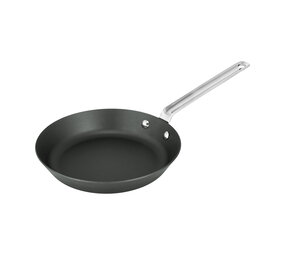
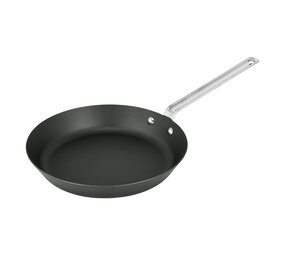
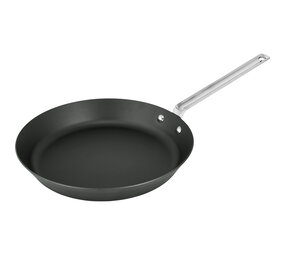
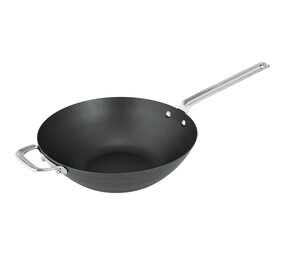
The design philosophy is recognisably Scandinavian: a clean, functional appearance without unnecessary ornamentation. The long handle is stainless steel with steel rivets - strong, hygienic, and oven- and BBQ-proof without heat absorption. The sides of the pans are generously flared, making it easier to toss ingredients and turn delicate pieces of meat or fish. The Black Iron range includes frying pans in multiple sizes, a wok and a grill pan.
Pre-seasoned and ready to cook - getting better with every use
The Black Iron pan is pre-seasoned at the factory and ready to cook with straight from the box. No initial seasoning ritual is needed. Simply rinse with hot water and a brush (no washing-up liquid), dry thoroughly, and start cooking.
To build the patina as quickly as possible, start with fatty foods during the first few uses: bacon, eggs in butter, fried potatoes. Each cook adds another layer to the natural non-stick surface. The more you use the pan, the better it performs.
If at any point the patina looks uneven or thin - for example after cleaning off stubborn residue - you can reinforce it with a quick re-seasoning:
- Dry the pan thoroughly on low heat on the stovetop.
- Apply a very thin layer of neutral oil to the cooking surface.
- Heat on high until the oil just begins to smoke, then remove from heat and allow to cool.
- Wipe away any excess oil with kitchen paper.
Care
- ✅ Clean with hot water and a brush - no washing-up liquid. Soap damages the built-up patina. For stubborn residues: soak in hot water and then remove with a brush.
- ✅ Dry the pan immediately and thoroughly after cleaning. Carbon steel oxidises quickly with prolonged moisture contact. Best to dry briefly on low heat on the stovetop.
- ✅ Apply a thin layer of oil after drying if the pan is to be stored for an extended period.
- ✅ Never in the dishwasher. Aggressive detergents and high temperature completely destroy the patina.
- ✅ Avoid acidic ingredients in a young patina. Tomatoes, citrus fruit, vinegar and wine can damage a patina that has not yet fully developed. After several months of intensive use, acid resistance increases.
- ⚠️ Light rust is recoverable. Remove rust with fine steel wool or fine sandpaper, wash the pan, dry thoroughly and re-season. The pan is not ruined.
- ⚠️ Avoid prolonged soaking in water. This is the fastest way to cause rust.
Specifications
- Manufacturer: Scanpan A/S, Ryomgaard, Denmark (founded 1956)
- Material: Black carbon steel, 3.0 mm
- Pre-seasoning: Vegetable oil (factory-applied) - ready to use straight from the box, no initial seasoning required
- Handle: Stainless steel, long, with steel rivets
- Heat sources: All heat sources including induction, oven, BBQ and open fire
- Oven resistance: Unlimited (no synthetic components)
- PFAS-free: Yes - no coating whatsoever
- Dishwasher safe: No - hand-wash with hot water and brush only
- Maintenance: Regular re-seasoning required
- Origin: Scandinavia / Denmark (design and brand)
Other categories in Pots & Pans
Scanpan Black Iron
Scanpan Black Iron - carbon steel as the professional kitchen knows it
The Black Iron series is Scanpan's answer to one of the oldest and most proven materials in culinary history: carbon steel. While the brand is internationally best known for its patented non-stick aluminium pans, Black Iron represents an entirely different cooking philosophy - one where no coating determines cooking performance, but the material itself, the technique, and time.
Scanpan was founded in 1956 by the Brund family in Ryomgaard, a small town on the Djursland peninsula in Denmark. The company grew into one of the most respected Scandinavian kitchen brands in the world, exporting to more than 50 countries. All non-stick aluminium products are still cast at the factory in Ryomgaard - by hand, under 250 tonnes of pressure, from recycled aluminium. That Scandinavian design discipline - functional, timeless, uncompromising in quality - is also the foundation of the Black Iron series. But the material is fundamentally different.
The material: black carbon steel at 3 mm
The pans in the Black Iron series are made from black carbon steel, 3.0 mm thick. Carbon steel is an alloy of iron and carbon - typically 0.5 to 1.5% carbon - without the chromium addition that makes steel stainless. The result is a material with its own distinctive and valuable properties.
Heat conductivity and response
Carbon steel conducts heat quickly and responds immediately to changes in the heat source. This is the crucial difference from cast iron: cast iron retains heat for longer but responds slowly; carbon steel heat is directly controllable. For a cook who wants to switch between intense searing and delicate finishing, carbon steel is the ideal choice. The 3 mm thickness is a deliberate choice: thick enough for stable heat distribution and structural integrity, thin enough for fast response and ease of handling.
Maximum heat resistance
Carbon steel withstands very high temperatures - significantly higher than synthetic non-stick coatings. The Black Iron pans are suitable for use on all heat sources (including induction), in the oven, on the barbecue and over open fire. There is no upper limit to oven temperature. This makes the series particularly suited to techniques where extreme heat is essential: hard-searing meat for a perfect Maillard reaction, deglazing the pan, or finishing dishes in the oven that were started on the stovetop.
The patina - the living cooking surface
Carbon steel develops a patina with use: a layer of polymerized fat that bonds molecularly to the steel surface. This is not a chemical coating but a completely natural process. When oil or butter is heated at high temperature in the pan, the fat molecules undergo a polymerization reaction: they change from liquid fat into a hard, wear-resistant, smooth layer that adheres to the iron. That layer is the pan's cooking surface.
With each use the patina becomes thicker, stronger and more even. A well-seasoned carbon steel pan releases food over time almost as easily as a pan with synthetic non-stick coating - but without any coating, without replacement, without any upper temperature limit. The patina is also self-repairing: small areas of damage are naturally replenished with normal use. The more and more varied the pan is used, the better the cooking surface becomes.
Comparison with cast iron
- Weight - Carbon steel is significantly lighter than cast iron of comparable size. The 3 mm thickness of the Black Iron series provides rigidity without the heaviness of cast iron. Easier to lift, easier to toss.
- Heat response - Carbon steel responds faster to temperature changes than cast iron. Better control, lower risk of overcooking or burning.
- Heat distribution - Cast iron distributes heat more evenly across the entire surface during prolonged use; carbon steel has a faster per-zone response.
- Patina development - Carbon steel has a smoother surface than cast iron, allowing the patina to build more evenly and non-stick properties to develop more quickly.
- Induction - Both materials work excellently on induction. Carbon steel has an advantage in larger formats (such as woks) due to the thinner wall, which allows better heat distribution on induction.
Scanpan and carbon steel - a different branch of the same brand
The Black Iron series deliberately sits outside Scanpan's core business. Where the non-stick aluminium pans from Ryomgaard focus on ease of use, minimal oil use and low-maintenance cooking experiences, Black Iron asks for involvement: the patina needs to be built up over time, it requires conscious maintenance, and it rewards the user with a cooking surface that only gets better. That is a different promise - and an honest one.
The design philosophy is recognisably Scandinavian: a clean, functional appearance without unnecessary ornamentation. The long handle is stainless steel with steel rivets - strong, hygienic, and oven- and BBQ-proof without heat absorption. The sides of the pans are generously flared, making it easier to toss ingredients and turn delicate pieces of meat or fish. The Black Iron range includes frying pans in multiple sizes, a wok and a grill pan.
Pre-seasoned and ready to cook - getting better with every use
The Black Iron pan is pre-seasoned at the factory and ready to cook with straight from the box. No initial seasoning ritual is needed. Simply rinse with hot water and a brush (no washing-up liquid), dry thoroughly, and start cooking.
To build the patina as quickly as possible, start with fatty foods during the first few uses: bacon, eggs in butter, fried potatoes. Each cook adds another layer to the natural non-stick surface. The more you use the pan, the better it performs.
If at any point the patina looks uneven or thin - for example after cleaning off stubborn residue - you can reinforce it with a quick re-seasoning:
- Dry the pan thoroughly on low heat on the stovetop.
- Apply a very thin layer of neutral oil to the cooking surface.
- Heat on high until the oil just begins to smoke, then remove from heat and allow to cool.
- Wipe away any excess oil with kitchen paper.
Care
- ✅ Clean with hot water and a brush - no washing-up liquid. Soap damages the built-up patina. For stubborn residues: soak in hot water and then remove with a brush.
- ✅ Dry the pan immediately and thoroughly after cleaning. Carbon steel oxidises quickly with prolonged moisture contact. Best to dry briefly on low heat on the stovetop.
- ✅ Apply a thin layer of oil after drying if the pan is to be stored for an extended period.
- ✅ Never in the dishwasher. Aggressive detergents and high temperature completely destroy the patina.
- ✅ Avoid acidic ingredients in a young patina. Tomatoes, citrus fruit, vinegar and wine can damage a patina that has not yet fully developed. After several months of intensive use, acid resistance increases.
- ⚠️ Light rust is recoverable. Remove rust with fine steel wool or fine sandpaper, wash the pan, dry thoroughly and re-season. The pan is not ruined.
- ⚠️ Avoid prolonged soaking in water. This is the fastest way to cause rust.
Specifications
- Manufacturer: Scanpan A/S, Ryomgaard, Denmark (founded 1956)
- Material: Black carbon steel, 3.0 mm
- Pre-seasoning: Vegetable oil (factory-applied) - ready to use straight from the box, no initial seasoning required
- Handle: Stainless steel, long, with steel rivets
- Heat sources: All heat sources including induction, oven, BBQ and open fire
- Oven resistance: Unlimited (no synthetic components)
- PFAS-free: Yes - no coating whatsoever
- Dishwasher safe: No - hand-wash with hot water and brush only
- Maintenance: Regular re-seasoning required
- Origin: Scandinavia / Denmark (design and brand)