


 Frying pans & Sauté pans
 Non-stick
 Stainless steel
 Carbon steel
 Cast iron
 Cooking pots
 Demeyere Silver
 Scanpan Impact
 Scanpan Fusion 5
 Silampos Supreme Pro
 Silampos Grand Hotel
 Stellar Profile
 Stellar Equinox
 Stellar Eclipse
 Habonne Royal
 Korkmaz Proline
 Korkmaz Perla
 Sauteuses
 Dutch ovens
 Chasseur
 Lava
Lava Victoria
 Other
Other Grills & Grill pans
 Woks
Woks Carbon steel & cast iron
 Stainless steel
 Non-stick
 Kettles
 Fondue
 Tajines
 Pressure cookers
 Smoking pans
 Poffertjes pans
 Lids
Lids Splatter screens
 Miscellaneous
 Paella
 Japanese knives
 Kai Shun Classic
 Kai Shun Classic White
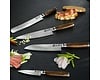 Kai Shun Premier
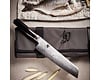 Kai Shun Premier Minamo
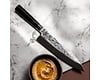 Kai Shun Pro Sho
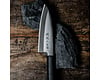 Kai Kinju & Hekiju
 Kai Seki Magoroku KK Yanagiba
 Kai Seki Magoroku Kaname
 Seki Magoroku Migaki
 Kai Seki Magoroku Redwood
 Kai Seki Magoroku Shoso
 Kai Wasabi Black
 Kai Specialties
 Miyabi 7000 D
 Miyabi 4000 FC
 Miyabi 800 DP
 Miyabi 6000 MCT
 Miyabi 5000 MCD
 German knives
 Wüsthof Classic
 Wüsthof Classic Ikon
 Wüsthof Ikon
 Wüsthof Epicure
 Wüsthof Gourmet
 Burgvogel Oliva
 Robert Herder
 French knives
 Elephant ****Sabatier forged stainless steel pakkawood
 Elephant ****Sabatier forged stainless steel olivewood
 Elephant ****Sabatier forged carbon steel pakkawood
 Elephant ****Sabatier forged carbon steel olivewood
 Elephant ****Sabatier stamped stainless steel
 Laguiole en Aubrac Gourmet
 Laguiole en Aubrac Classique
 Pallares Solsona
 Carbon steel kitchen knives
 Stainless steel kitchen knives
 Cleavers
 Steak knives
 Folding knives
 Steak knives
 Pallares Solsona
 Wüsthof
 Laguiole en Aubrac
 Kai / Shun
 Saladini
 Laguiole Style de Vie
 Other
Other Honing and sharpening
 Naniwa Chosera Pro
 Naniwa Advance
 Naniwa Standard
 Other whetstones
 Sharpening rods
 Honing steels
 Knife sharpeners
 Accessories
 Accessories
 Knife guards
 Knife magnets
 Knife blocks
 Knife bags
 Bread knives
 Cleavers
 Knife sets
 Simple kitchen knives
 Folding knives
 Victorinox
 Spyderco
 Böker
Böker Coutellerie G.R.
  Laguiole en Aubrac
 Nontron
 Opinel
 Cheese knives
 Oyster knives
 Miscellaneous
 Stellar Poise
 Graters, shavers, mandolines
 Mandolines
 Microplane Master
 Microplane Premium Classic
 Microplane Gourmet
 Microplane Professional
 Other Microplanes
 Other
Other Silicone tools
 Whisks
 Strainers & Colanders
 Spatulas
 Stainless steel
 Silicone
 Wood & Pressed wood
 Plastic
 Mortars & Pestles
 Tongs & Tweezers
 Kitchen shears
 Garlic presses
 Mills & Grinders
 Peugeot Paris
 Peugeot Paris Chef
 Peugeot ParisRama
 Peugeot Paris Rouge Passion
 Peugeot various
 Zassenhaus
 Brushes
 Ladles & Serving spoons
 Nutcrackers
 Peelers
 Oyster, lobster, snail
 Mashers
 Skimmers / frying scoops
 Funnels
 Ice cream scoops
 Pizza shovels & Pizza stones
 Can openers
 Squeeze bottles
 Meat mallets
 Skewers
 Miscellaneous kitchen aids
 Tortilla presses
 Citrus presses
 Baking tins & molds
 Springform pans
 Quiche & flan tins
 Bundt pans
 Cake & bread tins
 Muffin trays
 Madeleines, savarins, angel food
 Non-stick
 (Anodized) aluminum
 Silicone
 Cast aluminum
 Ceramic
 Baking trays
 Pastry rings
 Small baking molds
 Baking cups
 Paper Panettone molds
 Chocolate
 Polycarbonate molds
 Silicone molds
 Miscellaneous chocolate tools
 Chocolate food coloring
 Chocolate
 Books
Books (Cookie) cutters
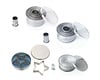 Cutter sets
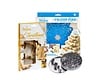 Cookie cutter sets
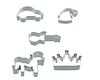 Individual cookie cutters
 Piping bags & nozzles
 Sets
Sets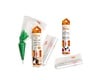 Piping bags
 Round piping nozzles
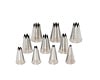 Star piping nozzles
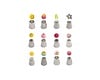 Miscellaneous
 Accessories
 Mixing bowls
 Rolling pins
 Bread
Bread Dough scrapers
 Palette knives
 Fondant tools
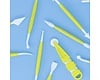 Modeling tools
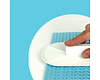 Impression mats
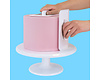 Smoothers, combs & spatulas
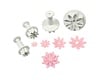 Fondant cutters / modelers
 Mats, paper and foil
 Acetate foil
 Silicone mats
 Cooling racks
 Brushes
 Turntables
 Cake servers
 Cake cutters / knives
 Candles
 Cake boxes
 Cake drums
 Other
Other Food coloring | gel
 Food coloring | oil based
 Food coloring | liquid
 Food coloring | powder
 Color spray & Velvet spray
 Edible markers
 Flavors
 Patis Decor natural flavors
 Patis Decor flavors
 PME flavors
 Extracts
 Glitters & decorations
 Magic sparkles (glitter flakes)
 Lustre snow
 Sugar flowers and decorations
 Sprinkles
 Fondant, Marzipan & Icing
 Fondant
 Royal icing, lace, etc.
 Biscuit Icing
 Cake drips
 Misc. ingredients
 Sugars and sugar substitutes
 Gold and silver leaf
 Mixes
Mixes Ravioli stamps
 Ravioli molds
 Pasta wheels / rollers
 Rolling pins
 Pasta makers
 Various
 Peugeot Ceramics
 Rectangular
 Square
 Other
Other Casseroles
 Roasting trays
 Terrines
 Thermometers
 Measuring jugs
 Scales
 Kitchen timers
 Measuring cups & spoons
 Other
Other Japanese tableware
 Gift sets
 Bowls
Bowls Salad bowls
 Plates
 Chopsticks
 Chopstick rests
 Cutlery
 Stellar Rochester
 Stellar Sterling
 Stellar Winchester
 Stellar Raglan
 Salad bowls
 Salad servers
 Butter dishes
 Butter knives
 Heim Söhne spoons
 Trivets and coasters
 Glasses
 Serving trays
 Other
Other Percolators / moka pots
 Bialetti parts
 French presses
 Milk frothers
 Coffee grinders
 Tampers
 Espresso tools
 Milk jugs
 Coffee filters
 Tea
Tea  Teapots
 Wine tools
 Waiter's friends / corkscrews
 Decanters
 Wine coolers
 Other
Other Cocktail tools
 Misc. bar tools
 Aprons
 Kitchen towels
 Oven mitts & pot holders
 Other
Other Wood
Wood Plastic
 Pressed wood fiber
 Wood oil
 Pots & Pans
 Knives & accessories
 Kitchen aids
 Baking & pastry
 Edibles
 Pasta
Pasta Oven
Oven Measuring
 Tableware
 Coffee & Tea
 Bar & wine
 To go & storage
 Textiles
 Books
Books Boards
 Olivewood
Yaxell HANA
Yaxell Hana - Japanese craftsmanship from Seki, accessible to everyone
Yaxell Corporation was founded in 1932 in Seki, a city in Gifu Prefecture that has been the centre of Japanese knife and sword making tradition for over 780 years. The city owes its position to a unique combination of raw materials: steel, charcoal, water and clay, which drew the first swordsmiths there during the Kamakura period. After the Sword Abolishment Edict of 1876, the masters of Seki redirected their craft towards kitchen tools - and the city became the heart of Japanese kitchen knife production that it remains to this day.
Yaxell is a family business, led by the Yamada family, and works exclusively with local artisans in Seki. Every knife is hand-forged, ground and finished - from striking the steel to engraving the logo. The company gained international recognition through its higher series (Ran, Gou, Zen) and grew into one of the most respected Japanese kitchen knife brands worldwide, present in the kitchens of top chefs and serious home cooks on every continent.
The Hana series is Yaxell's answer to a specific question: can a knife with all the hallmarks of Japanese craftsmanship - handmade in Seki, sharpened to 16 degrees per side, San Mai construction - also be accessible to a wider audience? The answer is yes. The Hana series offers honest Japanese craftsmanship without unnecessary luxury: no Damascus pattern, no exotic wood, no titanium. Just a well-made knife, perfectly sharpened, from the greatest knife-making city in the world.
The steel: MOVAX in San Mai construction
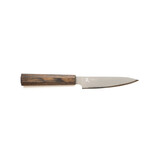
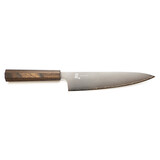
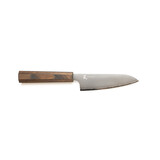
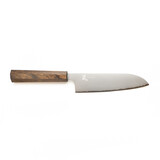
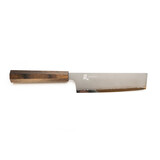
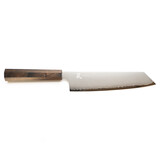
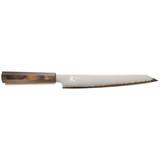
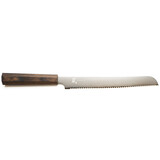
The Hana series blades are built in a San Mai construction: a MOVAX steel core clad on both sides with softer stainless outer layers. The outer layers protect the hard core, absorb shocks, and on the Hana produce the characteristic polished cladding line that visibly separates the core zone from the outer layers.
MOVAX - what is it?
MOVAX is the brand name Yaxell uses for the core steel alloy in the Hana series. The name decodes as Mo-Va-X: Molybdenum, Vanadium, and the designation "10" - pointing to AUS10, a high-quality stainless steel from Aichi Steel in Japan. AUS10 is one of the most popular steels for quality Japanese kitchen knives, known for its excellent balance between hardness, toughness and corrosion resistance.
Composition and properties
- Carbon (C: 0.95-1.10%) - A high carbon content for a stainless steel. This enables a fine, sharp cutting edge and contributes to good edge retention.
- Chromium (Cr: 13-14.5%) - Well above the 10.5% needed to qualify steel as "stainless." High chromium content delivers excellent corrosion resistance, including with acidic foods.
- Molybdenum (Mo) - Increases toughness and corrosion resistance. Molybdenum specifically helps prevent pitting corrosion - the small rust spots that can develop when knives are exposed to salt or acidic ingredients.
- Vanadium (V) - Refines the grain structure of the steel, improves wear resistance and contributes to a more stable cutting edge.
- Hardness: 58 HRC - This is a deliberately moderate hardness for a Japanese knife. Harder Japanese steels (60-67 HRC, such as VG10, Aogami or SG2) are sharper and hold their edge longer, but are also more brittle and more susceptible to chipping with improper use. The 58 HRC of MOVAX is the ideal compromise for a knife used daily, including by less experienced users: sharp enough for all kitchen tasks, forgiving enough not to require special handling.
- Edge angle: 16 degrees per side - Sharper than European chef's knives (20-22 degrees). This makes the Hana noticeably sharper than most Western knives, with a finer and cleaner cut.
- Finish: sandblasted - The blade has a satin sandblasted finish that visually accentuates the cladding line and gives the knife a clean, minimalist character.
MOVAX versus VG10
The higher Yaxell series (Ran, Gou) use VG10 as the core steel - the gold standard for Japanese kitchen knives. VG10 typically reaches 60-62 HRC and offers slightly better edge retention. MOVAX/AUS10 sits at 58 HRC and is less susceptible to chipping under harder use or less precise sharpening technique. For most home cooks the practical difference is small; the advantage of MOVAX lies in the lower threshold for use and maintenance.
The handle: octagonal pakkawood
The Hana series handle is made from dark brown walnut-coloured pakkawood with an octagonal cross-section. Pakkawood is a composite material of wood veneer impregnated with synthetic resin under high pressure - moisture-resistant, dimensionally stable and hygienic, with the appearance of natural wood.
The octagonal shape is a traditional Japanese handle geometry that provides excellent tactile orientation: the hand automatically feels the blade position without looking. During extended use the shape reduces hand and wrist fatigue by preventing the knife from rotating. The handle is seamlessly and permanently fitted to the blade - no seams, no rivets, no moving parts.
Care
- ✅ Hand-wash immediately after use. Never in the dishwasher.
- ✅ Dry immediately after washing.
- ✅ Use a wooden or plastic cutting board. Stone, glass and ceramic damage the cutting edge.
- ✅ Sharpen on a whetstone (1000-3000 grit for maintenance, 6000+ for finishing). The fine Japanese edge angle requires a whetstone or precision sharpener; honing steels and pull-through sharpeners are not suitable.
- ✅ Store on a knife block or magnetic strip. Loose storage in a drawer damages the edge.
- ⚠️ Not for chopping hard bones or frozen products. The thin Japanese geometry is for precision, not heavy chopping.
Specifications
- Manufacturer: Yaxell Corporation, Seki, Japan (founded 1932)
- Construction: San Mai (MOVAX core + stainless outer layers)
- Core steel: MOVAX (AUS10 equivalent), stainless
- Hardness: 58 HRC
- Edge angle: 16 degrees per side
- Grind: Double bevel (50/50)
- Finish: Sandblasted (satin)
- Handle: Octagonal pakkawood, dark brown walnut colour
- Fitting: Seamless, permanent
- Origin: Seki, Japan



Other categories in Knives & accessories
Yaxell HANA
Yaxell Hana - Japanese craftsmanship from Seki, accessible to everyone
Yaxell Corporation was founded in 1932 in Seki, a city in Gifu Prefecture that has been the centre of Japanese knife and sword making tradition for over 780 years. The city owes its position to a unique combination of raw materials: steel, charcoal, water and clay, which drew the first swordsmiths there during the Kamakura period. After the Sword Abolishment Edict of 1876, the masters of Seki redirected their craft towards kitchen tools - and the city became the heart of Japanese kitchen knife production that it remains to this day.
Yaxell is a family business, led by the Yamada family, and works exclusively with local artisans in Seki. Every knife is hand-forged, ground and finished - from striking the steel to engraving the logo. The company gained international recognition through its higher series (Ran, Gou, Zen) and grew into one of the most respected Japanese kitchen knife brands worldwide, present in the kitchens of top chefs and serious home cooks on every continent.
The Hana series is Yaxell's answer to a specific question: can a knife with all the hallmarks of Japanese craftsmanship - handmade in Seki, sharpened to 16 degrees per side, San Mai construction - also be accessible to a wider audience? The answer is yes. The Hana series offers honest Japanese craftsmanship without unnecessary luxury: no Damascus pattern, no exotic wood, no titanium. Just a well-made knife, perfectly sharpened, from the greatest knife-making city in the world.
The steel: MOVAX in San Mai construction
The Hana series blades are built in a San Mai construction: a MOVAX steel core clad on both sides with softer stainless outer layers. The outer layers protect the hard core, absorb shocks, and on the Hana produce the characteristic polished cladding line that visibly separates the core zone from the outer layers.
MOVAX - what is it?
MOVAX is the brand name Yaxell uses for the core steel alloy in the Hana series. The name decodes as Mo-Va-X: Molybdenum, Vanadium, and the designation "10" - pointing to AUS10, a high-quality stainless steel from Aichi Steel in Japan. AUS10 is one of the most popular steels for quality Japanese kitchen knives, known for its excellent balance between hardness, toughness and corrosion resistance.
Composition and properties
- Carbon (C: 0.95-1.10%) - A high carbon content for a stainless steel. This enables a fine, sharp cutting edge and contributes to good edge retention.
- Chromium (Cr: 13-14.5%) - Well above the 10.5% needed to qualify steel as "stainless." High chromium content delivers excellent corrosion resistance, including with acidic foods.
- Molybdenum (Mo) - Increases toughness and corrosion resistance. Molybdenum specifically helps prevent pitting corrosion - the small rust spots that can develop when knives are exposed to salt or acidic ingredients.
- Vanadium (V) - Refines the grain structure of the steel, improves wear resistance and contributes to a more stable cutting edge.
- Hardness: 58 HRC - This is a deliberately moderate hardness for a Japanese knife. Harder Japanese steels (60-67 HRC, such as VG10, Aogami or SG2) are sharper and hold their edge longer, but are also more brittle and more susceptible to chipping with improper use. The 58 HRC of MOVAX is the ideal compromise for a knife used daily, including by less experienced users: sharp enough for all kitchen tasks, forgiving enough not to require special handling.
- Edge angle: 16 degrees per side - Sharper than European chef's knives (20-22 degrees). This makes the Hana noticeably sharper than most Western knives, with a finer and cleaner cut.
- Finish: sandblasted - The blade has a satin sandblasted finish that visually accentuates the cladding line and gives the knife a clean, minimalist character.
MOVAX versus VG10
The higher Yaxell series (Ran, Gou) use VG10 as the core steel - the gold standard for Japanese kitchen knives. VG10 typically reaches 60-62 HRC and offers slightly better edge retention. MOVAX/AUS10 sits at 58 HRC and is less susceptible to chipping under harder use or less precise sharpening technique. For most home cooks the practical difference is small; the advantage of MOVAX lies in the lower threshold for use and maintenance.
The handle: octagonal pakkawood
The Hana series handle is made from dark brown walnut-coloured pakkawood with an octagonal cross-section. Pakkawood is a composite material of wood veneer impregnated with synthetic resin under high pressure - moisture-resistant, dimensionally stable and hygienic, with the appearance of natural wood.
The octagonal shape is a traditional Japanese handle geometry that provides excellent tactile orientation: the hand automatically feels the blade position without looking. During extended use the shape reduces hand and wrist fatigue by preventing the knife from rotating. The handle is seamlessly and permanently fitted to the blade - no seams, no rivets, no moving parts.
Care
- ✅ Hand-wash immediately after use. Never in the dishwasher.
- ✅ Dry immediately after washing.
- ✅ Use a wooden or plastic cutting board. Stone, glass and ceramic damage the cutting edge.
- ✅ Sharpen on a whetstone (1000-3000 grit for maintenance, 6000+ for finishing). The fine Japanese edge angle requires a whetstone or precision sharpener; honing steels and pull-through sharpeners are not suitable.
- ✅ Store on a knife block or magnetic strip. Loose storage in a drawer damages the edge.
- ⚠️ Not for chopping hard bones or frozen products. The thin Japanese geometry is for precision, not heavy chopping.
Specifications
- Manufacturer: Yaxell Corporation, Seki, Japan (founded 1932)
- Construction: San Mai (MOVAX core + stainless outer layers)
- Core steel: MOVAX (AUS10 equivalent), stainless
- Hardness: 58 HRC
- Edge angle: 16 degrees per side
- Grind: Double bevel (50/50)
- Finish: Sandblasted (satin)
- Handle: Octagonal pakkawood, dark brown walnut colour
- Fitting: Seamless, permanent
- Origin: Seki, Japan
