


 Frying pans & Sauté pans
 Non-stick
 Stainless steel
 Carbon steel
 Cast iron
 Cooking pots
 Demeyere Silver
 Scanpan Impact
 Scanpan Fusion 5
 Silampos Supreme Pro
 Silampos Grand Hotel
 Stellar Profile
 Stellar Equinox
 Stellar Eclipse
 Habonne Royal
 Korkmaz Proline
 Korkmaz Perla
 Sauteuses
 Dutch ovens
 Chasseur
 Lava
Lava Victoria
 Other
Other Grills & Grill pans
 Woks
Woks Carbon steel & cast iron
 Stainless steel
 Non-stick
 Kettles
 Fondue
 Tajines
 Pressure cookers
 Smoking pans
 Poffertjes pans
 Lids
Lids Splatter screens
 Miscellaneous
 Paella
 Japanese knives
 Kai Shun Classic
 Kai Shun Classic White
 Kai Shun Premier
 Kai Shun Premier Minamo
 Kai Shun Pro Sho
 Kai Kinju & Hekiju
 Kai Seki Magoroku KK Yanagiba
 Kai Seki Magoroku Kaname
 Seki Magoroku Migaki
 Kai Seki Magoroku Redwood
 Kai Seki Magoroku Shoso
 Kai Wasabi Black
 Kai Specialties
 Miyabi 7000 D
 Miyabi 4000 FC
 Miyabi 800 DP
 Miyabi 6000 MCT
 Miyabi 5000 MCD
 German knives
 Wüsthof Classic
 Wüsthof Classic Ikon
 Wüsthof Ikon
 Wüsthof Epicure
 Wüsthof Gourmet
 Burgvogel Oliva
 Robert Herder
 French knives
 Elephant ****Sabatier forged stainless steel pakkawood
 Elephant ****Sabatier forged stainless steel olivewood
 Elephant ****Sabatier forged carbon steel pakkawood
 Elephant ****Sabatier forged carbon steel olivewood
 Elephant ****Sabatier stamped stainless steel
 Laguiole en Aubrac Gourmet
 Laguiole en Aubrac Classique
 Pallares Solsona
 Carbon steel kitchen knives
 Stainless steel kitchen knives
 Cleavers
 Steak knives
 Folding knives
 Steak knives
 Pallares Solsona
 Wüsthof
 Laguiole en Aubrac
 Kai / Shun
 Saladini
 Laguiole Style de Vie
 Other
Other Honing and sharpening
 Naniwa Chosera Pro
 Naniwa Advance
 Naniwa Standard
 Other whetstones
 Sharpening rods
 Honing steels
 Knife sharpeners
 Accessories
 Accessories
 Knife guards
 Knife magnets
 Knife blocks
 Knife bags
 Bread knives
 Cleavers
 Knife sets
 Simple kitchen knives
 Folding knives
 Victorinox
 Spyderco
 Böker
Böker Coutellerie G.R.
  Laguiole en Aubrac
 Nontron
 Opinel
 Cheese knives
 Oyster knives
 Miscellaneous
 Stellar Poise
 Graters, shavers, mandolines
 Mandolines
 Microplane Master
 Microplane Premium Classic
 Microplane Gourmet
 Microplane Professional
 Other Microplanes
 Other
Other Silicone tools
 Whisks
 Strainers & Colanders
 Spatulas
 Stainless steel
 Silicone
 Wood & Pressed wood
 Plastic
 Mortars & Pestles
 Tongs & Tweezers
 Kitchen shears
 Garlic presses
 Mills & Grinders
 Peugeot Paris
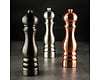 Peugeot Paris Chef
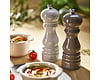 Peugeot ParisRama
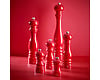 Peugeot Paris Rouge Passion
 Peugeot various
 Zassenhaus
 Brushes
 Ladles & Serving spoons
 Nutcrackers
 Peelers
 Oyster, lobster, snail
 Mashers
 Skimmers / frying scoops
 Funnels
 Ice cream scoops
 Pizza shovels & Pizza stones
 Can openers
 Squeeze bottles
 Meat mallets
 Skewers
 Miscellaneous kitchen aids
 Tortilla presses
 Citrus presses
 Baking tins & molds
 Springform pans
 Quiche & flan tins
 Bundt pans
 Cake & bread tins
 Muffin trays
 Madeleines, savarins, angel food
 Non-stick
 (Anodized) aluminum
 Silicone
 Cast aluminum
 Ceramic
 Baking trays
 Pastry rings
 Small baking molds
 Baking cups
 Paper Panettone molds
 Chocolate
 Polycarbonate molds
 Silicone molds
 Miscellaneous chocolate tools
 Chocolate food coloring
 Chocolate
 Books
Books (Cookie) cutters
 Cutter sets
 Cookie cutter sets
 Individual cookie cutters
 Piping bags & nozzles
 Sets
Sets Piping bags
 Round piping nozzles
 Star piping nozzles
 Miscellaneous
 Accessories
 Mixing bowls
 Rolling pins
 Bread
Bread Dough scrapers
 Palette knives
 Fondant tools
 Modeling tools
 Impression mats
 Smoothers, combs & spatulas
 Fondant cutters / modelers
 Mats, paper and foil
 Acetate foil
 Silicone mats
 Cooling racks
 Brushes
 Turntables
 Cake servers
 Cake cutters / knives
 Candles
 Cake boxes
 Cake drums
 Other
Other Food coloring | gel
 Food coloring | oil based
 Food coloring | liquid
 Food coloring | powder
 Color spray & Velvet spray
 Edible markers
 Flavors
 Patis Decor natural flavors
 Patis Decor flavors
 PME flavors
 Extracts
 Glitters & decorations
 Magic sparkles (glitter flakes)
 Lustre snow
 Sugar flowers and decorations
 Sprinkles
 Fondant, Marzipan & Icing
 Fondant
 Royal icing, lace, etc.
 Biscuit Icing
 Cake drips
 Misc. ingredients
 Sugars and sugar substitutes
 Gold and silver leaf
 Mixes
Mixes Ravioli stamps
 Ravioli molds
 Pasta wheels / rollers
 Rolling pins
 Pasta makers
 Various
 Peugeot Ceramics
 Rectangular
 Square
 Other
Other Casseroles
 Roasting trays
 Terrines
 Thermometers
 Measuring jugs
 Scales
 Kitchen timers
 Measuring cups & spoons
 Other
Other Japanese tableware
 Gift sets
 Bowls
Bowls Salad bowls
 Plates
 Chopsticks
 Chopstick rests
 Cutlery
 Stellar Rochester
 Stellar Sterling
 Stellar Winchester
 Stellar Raglan
 Salad bowls
 Salad servers
 Butter dishes
 Butter knives
 Heim Söhne spoons
 Trivets and coasters
 Glasses
 Serving trays
 Other
Other Percolators / moka pots
 Bialetti parts
 French presses
 Milk frothers
 Coffee grinders
 Tampers
 Espresso tools
 Milk jugs
 Coffee filters
 Tea
Tea  Teapots
 Wine tools
 Waiter's friends / corkscrews
 Decanters
 Wine coolers
 Other
Other Cocktail tools
 Misc. bar tools
 Aprons
 Kitchen towels
 Oven mitts & pot holders
 Other
Other Wood
Wood Plastic
 Pressed wood fiber
 Wood oil
 Pots & Pans
 Knives & accessories
 Kitchen aids
 Baking & pastry
 Edibles
 Pasta
Pasta Oven
Oven Measuring
 Tableware
 Coffee & Tea
 Bar & wine
 To go & storage
 Textiles
 Books
Books Boards
 Olivewood
Nontron (Coutellerie Nontronnaise)
Nontron
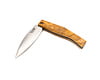
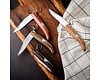
The knife of Nontron is widely regarded as the oldest in France. It has been made in the same small town in the Périgord for centuries: a slender boxwood handle marked with a mysterious woodburned symbol, a blade shaped like a sage leaf, and a turning ferrule that locks the folding blade open. Today one workshop still makes it, by hand, exactly where it began.
Why this knife is different
First named in a Paris text in the early 13th century, the Nontron is widely regarded as the oldest knife in France.
Handles turned from Périgord boxwood, woodburned with the mysterious ‘fly’ that has marked Nontron knives for generations.
A rotating brass or nickel-silver collar locks the open blade, a Nontron signature first recorded in the 1600s.
Still made in one small Périgord workshop by around twenty artisans, recognized as a living heritage craft.
At a glance
| Origin | Nontron, Périgord Vert, Dordogne, France |
| Reputation | Regarded as the oldest knife in France |
| The house | Coutellerie Nontronnaise, established 1928 |
| Handles | Boxwood, walnut, ebony and other woods |
| Decoration | Pyrography: the woodburned fly and fine stippling |
| Blades | Carbon steel, stainless steel or Damascus |
| Making | Around forty steps, by hand, roughly twenty artisans |
| Recognition | Living Heritage Company (Entreprise du Patrimoine Vivant) |
A knife older than the history books can date
The Nontron knife takes its name from the small town in the Périgord Vert where it has been made for centuries. Its history runs so deep, and is so wrapped in legend, that no one can fix a firm date on it. What experts agree on is simpler: the Nontron is regarded as the oldest knife in France. A Paris text from the early 13th century, Guillaume de la Villeneuve’s Nomenclature des crieries de Paris, already speaks of ‘Périgord knives’.
Cutlery took root here because of geography. Everything a knife-maker needed was close at hand: local iron ore, so tied to the town that the mineral nontronite carries its name, the boxwood forests of the Périgord hills, and the cold, clear water of the Bandiat river for tempering the blades. The Gaulish Petrocorii who lived here were celebrated ironworkers, praised in antiquity by the Greek geographer Strabo.
By the 17th century the trade was well established. Around 1653 Guillaume Legrand, a master cutler from Paris, settled in Nontron, and the first written records of the knife’s turning ferrule date from this period. A century later the wider Périgord counted dozens of cutleries, yet Nontron itself stayed a small workshop town where a few families, above all the Bernards and the Petits, carried the craft from one generation to the next.
The World Wars thinned their ranks. During the First World War the town’s cutlers were set to making locking knives for the French Ministry of War, and by the late 1920s only the Petit workshop remained. It became the Coutellerie Nontronnaise in 1928. Passed from the Chaperon family to new owners across the 20th century, the workshop has belonged to the Forge de Laguiole since 1992, with a stated aim of keeping the know-how in Nontron while carrying it forward. A new atelier opened in the town in 2000, and today around twenty cutlers still make the knife there by hand.
The oldest knife in France
Born in Nontron, in the Green Périgord, from local iron, local boxwood and the waters of the Bandiat. Still made in the same town today.
The mystery of the fly
Look closely at a boxwood Nontron and you will find it covered in fine woodburned marks: rows of small dots and a recurring motif of an upturned V crowned with three points. Nontron calls this motif the fly, and its origin and meaning have been lost. Some read it as a religious symbol, others as the compass of the Compagnons du Devoir, the journeymen craftsmen who once passed through the town. What is known is that the pyrography appeared alongside the clog-shaped handle, and that it is burned only onto boxwood.
The fly. An inverted V ringed by three points. A traditional pocket knife carries five flies and four rows of stippling, applied with two heated irons.
Boxwood only. The marks are burned freehand and belong to the boxwood models. Most other woods are left plain, so the pattern stays special.
A maker’s mark. Over the centuries the fly became the sign of authenticity, the detail that tells a real Nontron from an imitation.
Anatomy of a Nontron knife
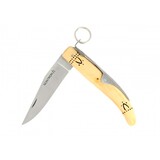
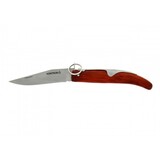
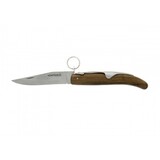
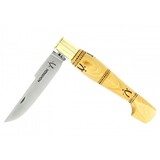
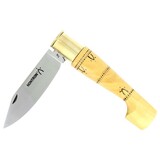
The shape has barely changed in generations. A slender boxwood handle, often finished as a carp tail or a clog, a blade ground to the outline of a sage leaf, and a ferrule at the join. On the folding knives that ferrule turns to lock the blade open, an idea first recorded in Nontron in the 17th century.
Boxwood, patiently dried. Handles are turned from Périgord boxwood aged at least four years, so the wood is stable and stays true. Walnut, ebony and other woods are used too.
The turning ferrule. A brass or nickel-silver collar that rotates to lock the open blade, the detail that has defined the Nontron folding knife for centuries.
Blades with character. Blades are made in carbon steel, stainless steel or Damascus, each ground, centered and sharpened by hand.
Around forty steps. From sawing the wood to the final sharpening, a single knife passes through roughly forty operations, and every one is done by a cutler by hand.
The last house of the Nontron knife
Coutellerie Nontronnaise is the only workshop that still makes the Nontron knife, and it is recognized as a Living Heritage Company (Entreprise du Patrimoine Vivant), a French state label reserved for rare craft skills. Around twenty artisans work in the Nontron atelier, which doubles as a small museum where visitors can watch the knives being made.
Tradition here is not frozen. Alongside the historic pocket knives and table knives, the house has invited designers such as Christian Ghion and Olivier Gagnère to reinterpret the oldest French knife for the modern table. Its cutlers are a fixture of the Fête du Couteau, the knife festival held in Nontron each summer, and once held a Guinness record for the world’s smallest folding knife, a piece just ten millimeters long.
Living with a handmade knife
Keep it out of the dishwasher. Boxwood handles and carbon blades should be washed by hand and dried at once. Treated this way, a Nontron lasts for generations.
A little oil. A drop of oil on the blade and the pivot now and then keeps a carbon edge bright and the folding action smooth.
Patina is normal. Carbon steel darkens with use. This patina protects the blade and is part of the character of a working knife, not a flaw.
Sharpen gently. Keep the edge with a fine stone or a steel. Well cared for, a Nontron is a companion for a lifetime and beyond.
Other categories in Knives & accessories
Nontron (Coutellerie Nontronnaise)
Nontron
The knife of Nontron is widely regarded as the oldest in France. It has been made in the same small town in the Périgord for centuries: a slender boxwood handle marked with a mysterious woodburned symbol, a blade shaped like a sage leaf, and a turning ferrule that locks the folding blade open. Today one workshop still makes it, by hand, exactly where it began.
Why this knife is different
First named in a Paris text in the early 13th century, the Nontron is widely regarded as the oldest knife in France.
Handles turned from Périgord boxwood, woodburned with the mysterious ‘fly’ that has marked Nontron knives for generations.
A rotating brass or nickel-silver collar locks the open blade, a Nontron signature first recorded in the 1600s.
Still made in one small Périgord workshop by around twenty artisans, recognized as a living heritage craft.
At a glance
| Origin | Nontron, Périgord Vert, Dordogne, France |
| Reputation | Regarded as the oldest knife in France |
| The house | Coutellerie Nontronnaise, established 1928 |
| Handles | Boxwood, walnut, ebony and other woods |
| Decoration | Pyrography: the woodburned fly and fine stippling |
| Blades | Carbon steel, stainless steel or Damascus |
| Making | Around forty steps, by hand, roughly twenty artisans |
| Recognition | Living Heritage Company (Entreprise du Patrimoine Vivant) |
A knife older than the history books can date
The Nontron knife takes its name from the small town in the Périgord Vert where it has been made for centuries. Its history runs so deep, and is so wrapped in legend, that no one can fix a firm date on it. What experts agree on is simpler: the Nontron is regarded as the oldest knife in France. A Paris text from the early 13th century, Guillaume de la Villeneuve’s Nomenclature des crieries de Paris, already speaks of ‘Périgord knives’.
Cutlery took root here because of geography. Everything a knife-maker needed was close at hand: local iron ore, so tied to the town that the mineral nontronite carries its name, the boxwood forests of the Périgord hills, and the cold, clear water of the Bandiat river for tempering the blades. The Gaulish Petrocorii who lived here were celebrated ironworkers, praised in antiquity by the Greek geographer Strabo.
By the 17th century the trade was well established. Around 1653 Guillaume Legrand, a master cutler from Paris, settled in Nontron, and the first written records of the knife’s turning ferrule date from this period. A century later the wider Périgord counted dozens of cutleries, yet Nontron itself stayed a small workshop town where a few families, above all the Bernards and the Petits, carried the craft from one generation to the next.
The World Wars thinned their ranks. During the First World War the town’s cutlers were set to making locking knives for the French Ministry of War, and by the late 1920s only the Petit workshop remained. It became the Coutellerie Nontronnaise in 1928. Passed from the Chaperon family to new owners across the 20th century, the workshop has belonged to the Forge de Laguiole since 1992, with a stated aim of keeping the know-how in Nontron while carrying it forward. A new atelier opened in the town in 2000, and today around twenty cutlers still make the knife there by hand.
The oldest knife in France
Born in Nontron, in the Green Périgord, from local iron, local boxwood and the waters of the Bandiat. Still made in the same town today.
The mystery of the fly
Look closely at a boxwood Nontron and you will find it covered in fine woodburned marks: rows of small dots and a recurring motif of an upturned V crowned with three points. Nontron calls this motif the fly, and its origin and meaning have been lost. Some read it as a religious symbol, others as the compass of the Compagnons du Devoir, the journeymen craftsmen who once passed through the town. What is known is that the pyrography appeared alongside the clog-shaped handle, and that it is burned only onto boxwood.
The fly. An inverted V ringed by three points. A traditional pocket knife carries five flies and four rows of stippling, applied with two heated irons.
Boxwood only. The marks are burned freehand and belong to the boxwood models. Most other woods are left plain, so the pattern stays special.
A maker’s mark. Over the centuries the fly became the sign of authenticity, the detail that tells a real Nontron from an imitation.
Anatomy of a Nontron knife
The shape has barely changed in generations. A slender boxwood handle, often finished as a carp tail or a clog, a blade ground to the outline of a sage leaf, and a ferrule at the join. On the folding knives that ferrule turns to lock the blade open, an idea first recorded in Nontron in the 17th century.
Boxwood, patiently dried. Handles are turned from Périgord boxwood aged at least four years, so the wood is stable and stays true. Walnut, ebony and other woods are used too.
The turning ferrule. A brass or nickel-silver collar that rotates to lock the open blade, the detail that has defined the Nontron folding knife for centuries.
Blades with character. Blades are made in carbon steel, stainless steel or Damascus, each ground, centered and sharpened by hand.
Around forty steps. From sawing the wood to the final sharpening, a single knife passes through roughly forty operations, and every one is done by a cutler by hand.
The last house of the Nontron knife
Coutellerie Nontronnaise is the only workshop that still makes the Nontron knife, and it is recognized as a Living Heritage Company (Entreprise du Patrimoine Vivant), a French state label reserved for rare craft skills. Around twenty artisans work in the Nontron atelier, which doubles as a small museum where visitors can watch the knives being made.
Tradition here is not frozen. Alongside the historic pocket knives and table knives, the house has invited designers such as Christian Ghion and Olivier Gagnère to reinterpret the oldest French knife for the modern table. Its cutlers are a fixture of the Fête du Couteau, the knife festival held in Nontron each summer, and once held a Guinness record for the world’s smallest folding knife, a piece just ten millimeters long.
Living with a handmade knife
Keep it out of the dishwasher. Boxwood handles and carbon blades should be washed by hand and dried at once. Treated this way, a Nontron lasts for generations.
A little oil. A drop of oil on the blade and the pivot now and then keeps a carbon edge bright and the folding action smooth.
Patina is normal. Carbon steel darkens with use. This patina protects the blade and is part of the character of a working knife, not a flaw.
Sharpen gently. Keep the edge with a fine stone or a steel. Well cared for, a Nontron is a companion for a lifetime and beyond.
